Showing posts with label research. Show all posts

Sunday, 20 August 2017

Down the Rabbit Hole: Frederick Gorst and the ‘Gladstone Vase’

By Ellen O'Brien - “PhD student, book lover and tea addict, I spend my days researching and writing, with help from my bunny George. History is not quite so visible in Australia as in England… but it's there if you know where to look!”

Studying history can be a lot like late-night-procrasti-searching through the labyrinthine corridors of Wikipedia… you start with something fairly innocuous– a country house servant and a silver vase, for example– but one clue leads to another, and before you know it, you’re so far down the rabbit hole, you need a small crane and a search and rescue team to bring you back up.
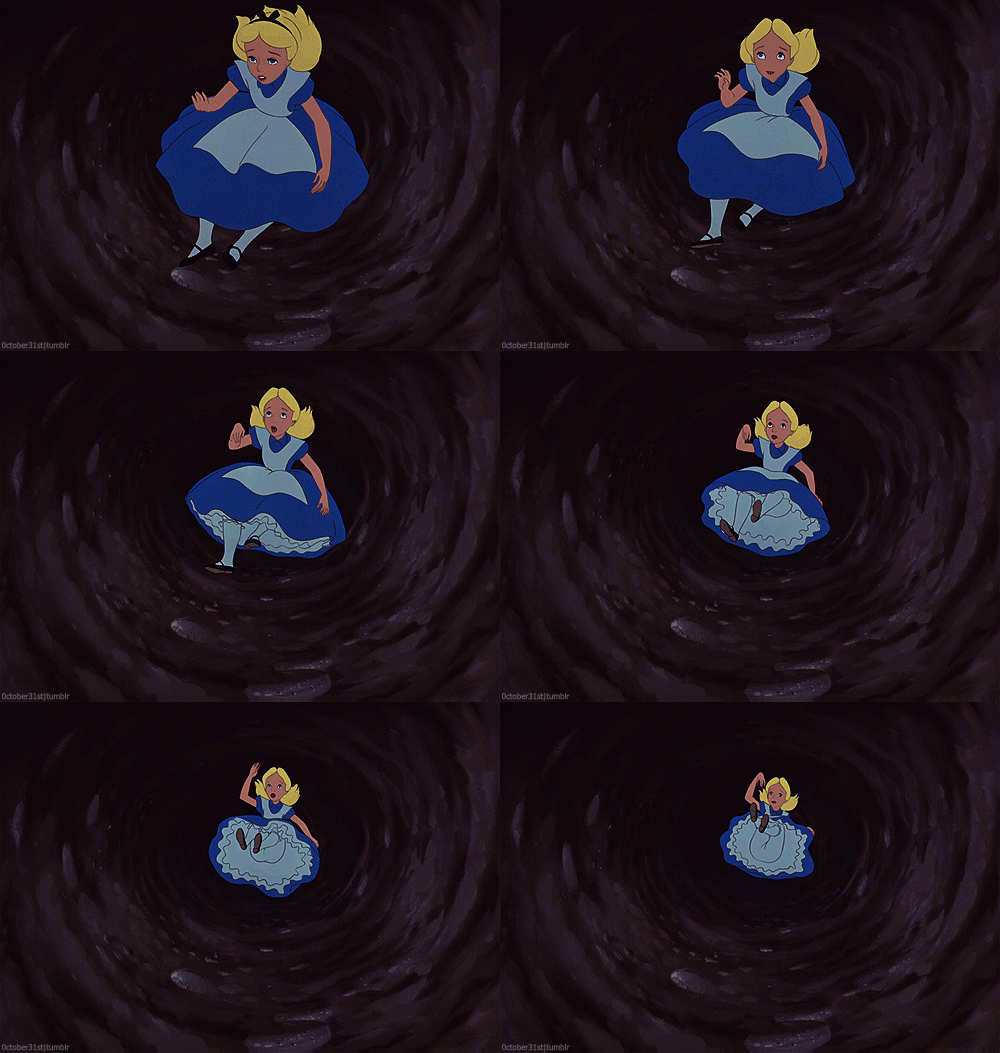
 Alice in Wonderland down the rabbit hole.

This has been my experience with a recent fragment of country house history– a relatively small part of the interminable PhD effort– one that keeps drawing me back, and each time, revealing something new. This fragment was initially the subject of a small conference paper on the relationship between servants and objects in the Victorian country house, and, unable to let me go, has morphed into a full-length article on objects as sites of memory, and the vagaries of servant memoirs.

Let me show you the fragment, as it first appeared to me.


What Gorst might have looked like, polishing the silver and how Gorst might have looked, in his footman’s livery).

In his memoir, Of Carriages and Kings, Victorian servant Frederick Gorst recounts a little of his time at Court Hey, the country house of Richard and Walter Gladstone, nephews of the four-times prime minister, William Gladstone. Gorst was especially reflective, for a footman, often impressed by a sense of ‘handling history,’ and, in the course of his duties, of being ‘allowed to glimpse, to touch for a moment, the lustrous past.’[1]


Surviving photograph of Court Hey, which was demolished in 1956.

One day, while cleaning the unused family silver that sat tarnishing in the vault, one item caught his eye. It was ‘an exquisite silver and gold vase about three feet tall… a copy of the famous Warwick vase,’ and had been ‘a legacy of Mr. Robertson Gladstone to his sons.’[2] (Gorst’s employers).


What the Gladstone Vase might have looked like. (This is actually a set of wine coolers in the same design, that was owned by the family).


Mr. Robertson, as the story goes, had been given the vase as a thank you present from the merchants of Liverpool, in ‘recognition of his munificent and timely gift’ of money to the starving workers and mill hands in the city. Why were they starving? The year was 1833, and slavery had just been abolished. There was now no sugar coming into the once-busy port, and ‘thousands of workers were idle and starving.’[3] However, the apparent generosity of Robertson Gladstone is clouded by one rather uncomfortable fact: his fortune came from the Gladstone family sugar plantations in Demerara… and the slaves who were forced to work there.  


1835 Abolitionist poster


The Gladstone family’s opposition to slavery was a source of some consternation to Gorst, who offers a strangely misleading account of their involvement in the matter. This deception has been the focus of my enquiry, but first, I investigated the vase, and its many historical connections and reincarnations.

It is an interesting case of an object possessing manifold cultural associations: the vase was not just a symbol of Britain’s participation in slavery, but is an exact replica of the Warwick Vase, which is linked to key figures of the late eighteenth century, and Britain’s diplomatic and classical past.

Dated to the 2nd century AD, the original Warwick vase was discovered by a Scottish painter, Gavin Hamilton, in the ruins of Hadrian’s Villa at Tivoli, and sold to Sir William Hamilton, a British diplomat. Sir William was an obsessive classicist who amassed large collections of vases, and, in the tradition of the ‘Grand Tour’, smuggled many back to England, despite an embargo on exporting antiquities (cough, Elgin marbles, cough).


Engraving of the ‘famous Warwick Vase.’

It is faintly ironic that the most famous of Hamilton’s vases bears the name of another collector. Having attempted, and failed, to sell it, Hamilton passed the job onto his nephew, Charles Greville, who was the younger son of the old Earl of Warwick (Hamilton’s brother-in-law). Greville made valiant, repeated attempts to carry off the deal, but he was not successful, and in the end, he sold it to his older brother, the Earl of Warwick, after whom it has been called ever since.


The Grevillea: named after Charles Greville.

Charles Greville is an interesting character (not least because the native Australian ‘grevillea’ plant was named after him- trust me, it’s exciting if you like gardening…). However, his rather more spectacular claim to fame comes through his mistress, a young woman called Emma Hart. Greville, who needed to find and marry a wealthy heiress, palmed Emma off on Hamilton, who took her to Naples as his mistress, and eventually married her there, after a five-year relationship. It was during their time in Naples that Lady Emma Hamilton (sound familiar yet?) met Lord Nelson, and the rest, as they say, was history.


Emma and Nelson: Britain’s favourite Napoleonic romance.

‘Take Lord Nelson with one limb,
Lady William Hamilton she fell for him,
With one eye and one arm gone west,
She ran like the devil and she grabbed the rest.
If women like that like men like those,
Why don’t women like me?’
(George Formby) 
.
And so, we circle back to Frederick Gorst, and his silver vase. It is possible to see how a single piece of silver, locked away in a cupboard, polished by a pensive footman at the end of the Victorian era, can take us right back through some of the more significant events of the preceding century. We have an object that is invested with historical meaning, that is linked to one of Queen Victoria’s prime-ministers, the Gladstone family’s role in the abolition (and support) of slavery, to England’s presence in the Mediterranean at the end of the eighteenth century, to their infamous habit of acquiring antiquities, and Britain’s favourite, Napoleonic romance.

At a quick scroll through, the flow of images in this post seem entirely disconnected– but they are not. They highlight the fact that, whenever you read about history, you will find moments of interconnectedness, association, and those wonderful flashes of ‘Well I never…’ Of course, if you’re feeling worn out and fed up with serious research, you can always do the same thing on Wikipedia for an hour or three… I highly recommend it.


[1] Gorst, 73
[2] Gorst, 71
[3] Gorst, 72

Sunday, 2 August 2015

An Inside Look: Just some of the questions I continue to ask myself during the course of my research.

It’s not very often, if at all, I write directly and in detail about the research I do and you might well ask why. Given that it is something I proclaim to both love and find fascinating, and given that I would call myself a public historian, why on earth do I not blog about my work more often? And it’s a question I often ask myself, especially when it comes to thinking of the topic for next week’s blog, and so you’d certainly be right to call me up on it. The thing is I don’t find it particularly easy to offer a clear and concise view on some of the issues that arise when studying this topic, because they can be very complex and multifaceted.

As an academic working within the field of animal studies you are forced to consider, amongst other things, the legal and ethical issues which can surround the particular topic you might be working on and which in turn, can lead you into impassioned debate and even confrontation – and sometimes I just don’t feel in a strong position to either defend or argue for a particular angle. For example, when visiting a zoological collection last year and being angered by the conditions in which the animals were kept, I was shocked to later discover that the zoo were meeting the legal requirements for keeping animals in captivity. It’s all too easily to respond based on your own morality, and that can be a good thing, but the conclusions you reach might not always be the ‘right’ ones and so I’ve learnt to tread a little more carefully before jumping in all guns blazing. However, I thought on this occasion I’d try and take you through a few of the questions and topics I often find myself contending with and deliberating on.

1. Zoos


Should they exist or shouldn’t they? What makes a ‘good’ zoo, if there is even such a thing? Why is the legislation around the keeping of animals in captivity so lax? Why will parliament not approve the ban on the use of wild animals in circuses? Or the keeping of some exotic animals as pets? Why are there still so many comparisons to be made between the 19th century, 20th century and 21st century when so much else has changed? I could go on.

With all these questions, just a sample of what I could think of, where do I even begin? One of the two events that led me to focus my dissertation on Charles Jamrach, involved asking myself the question “why did zoos spring up in the middle of urban areas during the nineteenth century?” and at the time I happened to be stood looking at the giraffe house at London Zoo. I’ve been to zoos and wildlife parks all my life – some good, some bad and some excellent (as far of course as they can be). I’ve grown up with a respect for wildlife and interest in it, some of which stems from those very visits. But as I’ve grown up, what was once awe inspiring and entertaining has become more educational, thought provoking and a topic much closer to my heart.

I look at a visit as an opportunity to learn about conservation, but also about the heritage of these institutions. For example when in Vienna last year, I visit the Tiergarten Schonbrunn and was as interested in, if not more so in fact, in the infrastructure and layout of the zoo, as I was in what was contained within the enclosures. There is a history there I want to understand and I think that is something zoological collections should be looking to impart on their visitors - show the changes that have occurred and own that past. Offer the context and circumstances in which these curious institutions arose to help people better understand ‘why’. Let’s stop disassociating and hiding from the unpalatable bits of that past. It can’t be changed, it was what it was, so let’s be honest about it and show the progress that’s been made since, in terms of our attitude towards animals (although, has there really been any? Another question I often wrestle with and have done a lot this past week, in the wake of the controversy over Cecil the lion. But that is a blog in itself).

However reticent I am to admit it, and regretful, I think there is little point in suggesting the demise of zoos and wildlife parks. They have a value in terms of education, conservation and funding projects that for some species, offer a last ditch attempt to bring them back from the brink of extinction. I just wish Zoos could lose the ‘entertainment’ label. I don’t think they should be entertaining, I think they should be a sharp reminder of the power we yield over the natural world and that we should being doing all we can to hand that back and leave well alone. I read recently John Berger’s view that ’in zoos [animals] constitute the living monument to their own disappearance’ (1) and couldn’t help but get a heavy heart. What a sorry state of affairs the relationship between mankind and animals is currently in.

2. Why does the legislation suck?


I’ve also become increasingly aware of the lax legislation that surrounds exotic animals generally in the UK. It seems archaic to me. Something that’s been neglected and over looked for far too long. I know there are a number of organisations out there who are pushing for change and we really need to get behind them.

Born Free’s summer 2015 Wildlife Times highlights some harrowing statistics about the numbers of exotic pets in the UK. They estimate for example that there are at least 7,000 pet monkeys and other primates in the UK. And then there is the sheer range of different species being kept as household pets, all of which was bought to light in a recent survey. This includes amongst others snow leopards, polar bears and tapirs as well as meerkats and venomous snakes. The article asks ‘Just because we are legally able to keep any animal, does this mean it is morally right?’ and I’d ask you the same question but also – why in the world does the law permit this? These are animals that are not just wild but some that are listed as species in need of protection (vulnerable, threatened, critically endangered etc.)

And then there is the fact that British Parliament can’t pass a bill to ban the use of exotic animals in circuses. The why is just beyond me – especially when you consider that other European countries have introduced this ban. Why hang on to this ‘traditional’ relic when so many people are against it? Are we not better than that? How can someone look at an animal in that sort of situation and feel that it is acceptable? I know it comes low down on the priority list when compared to other issues such as welfare, defence and the economy, but come on people can’t we just get it sorted out?

3. Why bother when nature has its own agenda?


Nothing appears to be safe- whether from humans or from nature. For example, I read very recently how 10 Asiatic lions have been reportedly killed in the floods that hit Gujarat, which is a significant number when you consider that the remaining surviving population is believed to be only 523. This disaster has renewed criticism by some conservationists that the lions should not be kept in a single location (2) but I couldn’t help but think, is there any hope either with or without human intervention? Has the damage not already been done and are we not at a point where it’s irreparable in so many cases? But then the flip side to that view - I read another recent article which reports how the numbers of peregrine falcons have risen in Illinois, so much so that the species has been removed from state’s endangered and threatened list.

And so I end up right back at the beginning, questioning whether we ‘need’ zoos and what function they serve and whether we can actually make a difference.... I told you this wasn’t going to be straight forward.

4. When should I quit it all and become an animal activist?


When I read of the harsh reality in the way we treat animals - the huge number of species threatened and nearing extinction; or of those trapped in unfit cages and enclosures, used as photographers props and as circus entertainment, or shot for ‘sport’ – I get so enraged. Often my reaction to these things is “right, let’s get out there and do something” or “why?”, so often the question is why.

Three recent incidents particularly sparked this reaction. The first was the story of 66 chimpanzees abandoned by the company who had performed medical tests of them, after pledging ‘lifetime care’ when the laboratory was closed down. The second, was the overturning of South African Airlines ban on the transportation of hunting trophies, and third of course, was the hunting and death of Cecil (links 3 & 4 below). I want to get out there and do something, I just don’t know what or how at this moment in time. I really want to make an impact and not some half-hearted attempted that falls flat on its face. Perhaps using the work I’ve done and am about to do, I can influence policy, educate and help to make lasting changes. “Why haven’t you done so already?” I hear you ask, and another good question. I suppose my Born Free subscription isn’t quite enough is it…. and I think in light of recent news, I’d better get straight on it!

5. What’s the role of Natural History Museums?


Again, this is a topic I’ve engaged with a fair bit of late and it’s no more straight forward than any of the previous. I read recently somewhere natural history museums described as “cemeteries of corpses” – a phrase which evoked two images for me. On the one hand, it seemed to have rather negative connotations; why would we want to make pilgrimages to these sorts of places, to look at the dead and ‘decaying’. It all seems rather morbid when you think about it. Why look at something still, lifeless and posed when you could look at something full of life, via the internet, TV, in a wildlife park or best of all, in its natural environment. And in part, I can see the argument. I recently had a conversation with someone who argued this case, expressing criticism of the NHM South Kensington for the faded mammal taxidermy specimens that are on display, for this person had in fact wanted to be able to show their child a vibrant, impressive looking male lion.

So just why do we go to NHM’s? Is it to see, to study and to compare creatures – their physiognomy, colourings and size? Or is it to understand the work taken by that institution as a scientific organisation? I think in part it’s both, but I don’t think that the latter is something that is really explored enough by NHM’s and transmitted to the public as well as it could be. Natural history museums are oddities in that they are “cemeteries of corpses”, dead specimens put on display for public consumption. But so much more goes on behind the scenes, work of global scientific significance and I think that is so often overlooked. NHM’s aren’t just preserving specimens but they are continuing to carry out the scientific and educational work they have always done, so let’s inform people about that. There is a reason why these museums have in their stores, hundreds of specimens of creatures from around the world. Let’s tell people what drove, and continues to drive that collecting and scientific research.

In a positive step there have been some successful attempts to contextualise collections and explain these ‘oddities’ by doing exactly that. Both the Horniman Museum and Gardens and the NHM Tring have attempted to address this; the Horniman with its new introduction to the Natural history gallery and Tring with its new Rothschild gallery. Both have attempted to contextualise the collections, explaining why they exist, what drove the people that began those collections and what else was going on at the time to influence it. It’s a much needed approach and one which can only improve people’s understanding of what at first glance, are pretty odd institutions.

It’s all too easy to forget that what is on display is only a small proportion of a collection and that much more is held in a museum’s store. It’s here that the real scientific value is to be seen and understood and that was something I really grew to appreciate very recently when shown some of the bird collection at the NHM Tring.

6. And, what should we be telling people about natural history collections?


Last one, I promise!

Recently when in an archive, I was approached by a mother with her two young boys who enquired as to what I was looking at and why. This moment was pretty significant for me for two reasons really. Firstly because it was the first time I really owned my claim to being a historian. But I was also struck by her response when I told her that I was looking at evidence for what specimens were being donated too and bought by this collection, by whom, where from etc. in order to try and map what was going on and why. I think I find this aspect particularly interesting because I’m looking for some sort of justification that this whole over exploitation that occurred throughout the 19th and early part of the 20th century, was in some way ‘worth it’ or ‘justifiable’. I don’t for a moment think it was, but I cling to the hope that there might just be something that makes it seem that tiny bit ‘ok’.

And that is exactly what this mother had said she’d tried to explain to her boys. That the animal specimens on display hadn’t been killed or died and preserved for nothing, and that the knowledge derived from them was hugely important. That’s what I want to believe too, and to a certain point, I do. But the more you encounter statistics that only 1 in 12 animals survived transportation to Britain, or that such and such died only days after it arrived, and that an animal was beaten to death for striking out – it really does destroy that belief. And even more so when you read that that is exactly what happens now, and again I can draw on a Wildlife Times article, in particular the one on cheetahs as ‘The ultimate status symbol’.

It’s all just very difficult because on the one hand, the history of the exotic animal trade is a colourful and fascinating one. I’ve been amazed to discover how far it impacted upon and reflected wider social, cultural, political and economic issues and it has enabled me to look at history in a very different way. However, while I maybe studying this subject and sharing my research, I do not for one moment condone what went on and what continues to go on, nor do I want to be seen as glorifying it by talking about it. I suppose, you have to learn to compartmentalise it in order to keep perspective and this is something I am still very much learning to do. The topics of animal welfare and animal rights are ones I feel very passionately about and there are often a lot of deep breaths to be heard when I’m in the archive and reading up on it, just as there has been in writing this, as I struggle to come to terms with the reality of what I might be reading.

(1) John Berger, Why Look at Animals? (London: Penguin Books, 2009), 36.
(2) http://www.independent.co.uk/news/world/asia/indian-floods-kill-10-endangered-asiatic-lions-in-gujarat-10390123.html
(3) http://www.dailymail.co.uk/news/article-3173127/The-heartbreaking-battle-save-66-chimpanzees-baby-left-starve-African-island-medical-firm-abandoned-finished-experimenting-them.html?ito=social-twitter_mailonline
(4) http://www.fastcompany.com/3048936/fast-feed/south-african-airways-lifts-ban-on-hunters-animal-trophies

Sunday, 19 July 2015

Happy as a pig in muck – Archives, archives and more archives! Part 2

Right, so where was I?

Ah Yes, that’s right, moving on from my little negative rant… After I got a little perspective on the whole situation and had a “that would make a good blog” moment, it was time to hit the next archive and see what else it could reveal in my hunt for new information on Mr Jamrach, to use in both my upcoming talk and exhibition. The great thing this time however, was that I needn’t even leave the comfort of my own home for this archive is all online.

For a reasonable subscription fee members of the public are able to sign up to the British Newspaper Archive (BNA) and access over 400 newspaper titles, spanning from 1710 to the 1960s – an invaluable resource for any researcher, both professional and amateur. I fast became a fan of this archive, for what a fantastic resource it offers its users! It’s easy to use and offers a wealth of material and I’ve really enjoyed navigating my way around and uncovering new little gems. Part of me wants to divulge some of that material, but then again, “spoilers”!

Previously the access I had to online newspaper archives came through the online e-resources access I had the luxury of using as a student at university. The Times Digital Archive and the 19th Century British Library Newspapers were both resources I used a lot when it came to working on both my undergraduate and postgraduate dissertations and had offered up some really interesting snippets of information. However once I’d left university, I lost that access and it forced me to look elsewhere. Hence I rediscovered the BNA, an archive I’d never really thought to utilise before. “Rookie error” I hear you cry!

Launched in 2011, the BNA is a partnership between the British Library and findmypast to digitise up to 40 million pages of the British Library’s vast collection of newspapers, over the course of the next 10 years (1). This enables researchers to search through thousands of articles by keyword, name, location, date or title, and see immediate results. Gone are the days of pain staking scrolling through microfiche and actual hard copies of papers - which can be a nice experience once in a while, but when researching on a large scale this resource is a genius one. And that is actually, exactly why I found myself putting aside a couple of days and dedicating that time to a thorough search of the archive. Before, had I had to do it ‘manually’, I’m not sure whether it would have been worth the time, unless of course I’d known exactly what I was looking for - a specific article or edition – and I think I could quickly have got disheartened with it. But there is no need for that with this archive; you can just explore it without that clear idea. I was able to find new snippets of information I had no previous idea about within seconds, and that made for a really exciting couple of days.

The Site


I found it to be a really user friendly database, offering users different ways to filter the results from announcement types to publication titles, date (YYYY/MM/DD) and even public tags (the sorting of articles into additional categories or topics such as news, classifieds, crime, art etc.). The technology used to recognise search terms also works well at picking out those key words for both basic and advanced searches.  And the character recognition software (OCR) is generally spot on, but some of the transcriptions, especially on the older stuff, can be a bit hit and miss. It does however, appear that the BNA acknowledge this limitation and do offer users the opportunity to correct the OCR errors with the ‘Edit Article Text’ option; therefore offering users a way to improve the quality of the database. How many people have used or will use this feature is, I guess, is open to speculation. Only those articles looked at will have any chance of being corrected, we’d hope correctly but there is no guarantee, and also, how will this be kept on top of as new material continues to be added? There are lots of unanswerable questions here, but I think the approach is definitely one to be commended.  

In terms of the images of the papers, they are of a high quality and are easily manipulated by users – zooming in/out and navigating around the page. It was worth, what I expect, was an extra expense, for the quality of images this resource provides is not always matched by its contemporaries. I have had a few experiences where I’ve viewed some online documents and the images have pixelated when enlarged, or been slow to load when navigating around a page. But like I say, I didn’t experience any of those problems here. Upon viewing an article, your attention is also easily drawn to your original search term, which is highlighted by a blue box around the word and the article tends to be a lighter shade than the rest of the page. This is hugely helpful given that each article appears within the full page view of the original document.

One particularly good aspect to this feature is that fact that it gives you the full context in which the article is appearing. You don’t view it in isolation and this really helps with understanding the article and what else was going on at the time. For example, one of the most well-known stories about Charles Jamrach relates to the escape of a tiger from a shipment, onto the Ratcliffe Highway, where it proceeded to attack a young boy named John Wade, in October 1857. Interestingly, one particular article which documented this event, featured just below another article that discussed Imperial Rule within India subsequent to the Indian Mutiny– and in a way it makes a subtle reference to the symbolism that the event of the escaping tiger evoked.

However, with this feature also comes a slight drawback when it comes to downloading or printing articles. As copies of the entire page view, the PDF’s that are produced are large, complete files, when in actual fact you might only want a small snippet or single article. And, from what I could see, there wasn’t the option to print or download just the single article; a feature I’d particularly liked when using 19th Century British Library Newspapers in the past. So I took to print screening the smaller articles, so as to just get the bit I wanted. Where this wasn’t possible, I did save the large ones but am wondering what I will do as and when I decide to print them. It could be a mammoth cut and paste exercise!

In terms of my own research, what can I say? At first I was really excited to see over 1,800 results bought back for my first search term, but very quickly realised that an article published in a national or regional paper would be published numerous times in smaller, local and provincial papers and so there was a fair bit less to look at than I had first anticipated. But I found this to be interesting in itself and quickly noticed a pattern in terms of which sort of articles were published at various times and also, reused at later dates. As you’d expect, the tale of the tiger featured heavily and appeared in over 300 articles, some of which appeared in the October or November of 1857 but some dated later and covered the court case, when Jamrach was sued by Wade’s parents for compensation, and others just reflected on that incident some 10 or 20 years later. So, just by observing that pattern, I was able to reconfirm how dominate that event was in forming society’s view of Charles Jamrach.

One thing I had been a little concerned about when subscribing to this archive was that there might be a usage cap on how many articles you can view in one session/month. But I did a bit of research and was relieved to find that this doesn’t appear to be the case. I was free to mosey about looking at what I wanted and really enjoyed the process of doing so.

Conclusions


The BNA has really opened up the collections of the British Library to a much wider audience and I think that can only ever be a good thing. In many ways it is democratising research and offering researchers of all kinds, access to an invaluable resource that can be at their fingertips in minutes – although, at a cost. I hope that this is a sign of more good things to come and wonder, whether there is scope for the project to run for longer if funding and resources can be found?

So….I know you’re probably all dying to know – what new gems did I uncover? Well it was a bit of a mixed bag really. Sadly, I discovered news reports dating from the 1870s that describe how Mr. Jamrach, “the well-known dealer in wild beasts” was charged at the Thames Police Court with assaulting his wife. (Whether this was Mr Jamrach Snr or Jnr thought, I have yet to determine). One particular report in the Leeds Times goes on to describe details of the two cases which were put to the court, Mrs. Jamrach’s informing of the violence to which she was inflicted, but then it being implied she was actually having an affair with the character witness and medical examiner in the case. The case for the defense was then put forward and the judge told of the “wretched, miserable life [he suffered] at the hands of the complainant”. In the end the summons was dismissed and the judge ruled that Mrs. Jamrach “keep the peace towards her husband for the next three months”.  Would we expect any other judgment given the time?

Then, there is one other final snippet that I will share with you, which is one that really stood out for me, partly because of its ludicrously, but also because it shows how present Jamrach’s was in the consciousness of society during the later half of the nineteenth century. I was very surprised to find a couple of articles dating from 1888 speculating as to the culprit behind the Whitechapel Murders and that actually implicated Jamrach’s. Having been compared to, or perhaps inspired by, Edgar Allan Poe’s short story “Murder in the Rue Morgue”, it appears it was actually suggested that the Whitechapel crimes were being committed due to the “same agency” as that in the story and that “it might be worthwhile... for the police to inquire at Jamrach’s and other dealers in the White-chapel Road and the neighborhood, if any large monkey has escaped”; while another directly claimed it could be down to “one of Jamrach’s Gorilla’s armed with a knife” (2). I had to laugh. It really does seem that Jamrach managed to get himself caught up in all sorts of new stories of the day! I’d say more, but would like to keep something back for those upcoming events – that’s after all what is has all been in aid of.

Monday, 13 July 2015

Happy as a pig in muck – Archives, archives and more archives! Part 1

This week I went very much back to basics and found myself in the archive, both in a physical and digital sense, conducting original primary research. I spent the best part of the week examining documents, some of which were over 200 years old, and loved every single minute of it – well, mostly, but all in good time! There was a sense of urgency in my attempts to plan as many archive visits as possible as I have a couple of big ‘events’ coming up in the next few months and as we all know, early preparation – especially given that I’m starting the PhD in September – is always a good idea! I do slightly feel as if I’ve bitten off more than I can chew, however I do tend to thrive under the pressure and I’m really excited about each of the projects!

So, I started this little research binge at Tower Hamlets Local History Library and Archive which was my first experience of a Borough Archive, unless you equate it to a County archive, then Surrey History Centre would be awarded that accreditation. But I digress. But how did I end up there one might ask? And in fact a couple of people have asked me that very question, as it’s a bit off the beaten track and not the most obvious choice to have made.

Well it was in fact the result of an enquiry placed with the Museum of London Docklands in search of material that might shed further light on the life and business of Charles Jamrach.  As part of my ongoing research I really want to try and figure out which London Docks Jamrach was importing into and whether any manifests survive that might tell us a bit more about the transportation of exotic cargo from ‘source’ to the ‘middle man/distributor’. It was therefore through correspondence with the archivist at the Museum of London Docklands that the suggestion was made that I make enquires with Tower Hamlets Library and Archive, as it was explained to me they hold material that focuses expressly on the Borough of Tower Hamlets. So this is exactly what I did and having received a positive response that they do hold some material, off I went, fortunately on a Saturday which meant no need to take a day of work!

 It transpires that the Archive and Library is open on the 1st and 3rd Saturday of the month, which for others in a position like I am is a huge benefit. Generally speaking, most archives tend to run 9-5 hours and so if you’re working, conducting research requires you taking holiday. But not in this case. The discovery of Saturday opening hours, especially in relation to a small and locally funded archive, that I expect only attracts a certain niche of researchers, was therefore a hugely pleasant surprise.
What I found was an archive with a lot of character but one I couldn’t help feel harks back to a bygone age. There was lots of wood cladding and retrograde steel shelfs and I wasn’t overly enthusiastic about the cataloguing system or lack thereof - an online version is coming soon which is fantastic, but as a researcher you are completely dependent on the assistance of the archive staff and of course, they can’t always know what you are looking for, because half the time you don’t really know until you find it!

I suppose I’ve been very spoilt in what I’ve experienced in other archives before now, as they’ve tended to be the larger, well-funded ones. For example, I am used to drawing up a list with reference numbers of what I’d like to see before I turn up, or the very least will have arranged this with an archivist beforehand. However that didn’t happen in this case. I was just told to turn up but then when I arrived, I was asked to provide references – catch 22. There is also a further complication which has arisen through subsequent correspondence because referencing on the original material isn’t particularly clear and it’s therefore been difficult for me to supply an accurate reference number for an item I’ve requested a copy of.

I feel pretty useless being so vague about it, as it’s normally something I am very particular about. I want to be able to go back to the original material and re-source what I found, but I also want others to be able to do the same thing if and when they need to – to both corroborate and question my work. And this was also made difficult by the fact that in a number of cases, the material I was looking consisted of newspaper clippings, cut out from the original newspapers and merely stuck to pieces of card, not necessarily with their provenance labelled anywhere. I found this all quite prohibiting as a researcher, so while I may have found some great material, and some pictures I’m very pleased to have found (we now have a face for the name for example), I’m a little hesitant to use them, as I’m not entirely sure where they’ve come from - at least not at the moment. All in all, it felt a little haphazard if I’m honest, but, on a positive note we did get there in the end and the archivist was very helpful in producing a lot more material that I had anticipated being available, so all in all it was a very beneficial visit and I left on a bit of a high it has to be said.

I also had my first microfiche experience at Tower Hamlets Archive which was simply terrifying. Never having used it before I did ask for a tutorial, which the archivist was very happy to provide, but the whole process still scared the life out of me and I had horrible visions of pushing the button too fast and the film bursting into flames and being lost forever. I’m not sure I’d race to use it again – I’d much rather stick to digital archives or those with pages I can turn!

So high on the success from earlier in the week I then headed off to another, arguably more well-known and well used archive, where I spent the next two days. The first day was brilliant. I was very impressed with the archive, the organisation and the staff who were very friendly and accommodating and who helped to create a really nice environment in which to work. As sometimes happens, the material was not all relevant or what I had been hoping to find, but I did find a few nice surprises and had a bit of a refresher in reading 19th century italicised handwriting. It felt really good to be back in the archive, in a more traditional sense – it had been too long, so all in all I had a really nice and productive day.

However, the second day, or rather, the last half an hour of that second day, was a completely different story. When it hit shift change we ended up with a bit of a jobsworth on the desk and I left feeling completely enraged. The demeanour of that particular archivist is exactly what can put ordinary members of the public off going to archives and what helps to preserve the image that archives are only for the use of the ‘elite’ and members of the ‘academy’. This particular archivist didn’t attempt to educate, but reprimanded in quite an unpleasant tone. Hands up, my original set up wasn’t as it should be, I did have part of the file (a corner) hanging over the edge of the desk, and rightly so she told me to place it more centrally on the desk – fine, I don’t have a problem with that. What I do have a problem with is her both doing it for me and the tone that she adopted. Teach me, don’t lecture me.

But the second thing that also really got me was being told that I couldn’t hold up the documents or angle them ever so slightly in an attempt to decipher, what is quite difficult handwriting to read. I am a historian. I appreciate that documents are fragile and I didn’t take the decision to lift that particular document lightly. Had it been fragile, or tearing or weak in any way I wouldn’t have chosen to look it at that way. I assessed what was in front of me and reacted suitably. And I think that particular archivist needs to appreciate that. As visitors to the archive, we’re not all inferior because we don’t hold the title of archivist.

Documents like those I had been viewing, have been kept to be studied and that’s all I was doing. There was no man handling, just holding it lightly at different angles – and the insistence that they could offer a magnifying glass, I’m afraid, wasn’t go to make that task any easier. The size of the text wasn’t the issue, but had I been asked rather than pre-judged, I might have been able to explain that.
I know archives have rules and guidelines for a reason, but I also think the value in their existence is the use people are able to make of them. Provided people are respectful and careful with the material they handle, we shouldn’t be reprimanded for how we hold a document. It’s a bit backward and old fashioned for my liking - I wouldn’t be surprised if this same archivist favoured the white glove approach as well!

Just why I’m on my soapbox - this particular individual even prohibited a visitor taking a picture of the library. Not specific items or artefacts, just the room as an entity. I mean come on?! Archives shouldn’t be closeted, mysterious entities shut off from the world. They can offer so much, but people need to know they are there in the first place. If anything, that’s what I took most from my experience of Tower Hamlets Archive. I needed to know it was there before it could be of any use to me and what use it was?! The whole thing just really grated on me – especially as it didn’t appear to be the archives’ ethos, just the ethos of that particular archivist.

I can’t help but think, if I felt intimidated having used numerous archives in the past, how would someone inexperienced feel? It really would be enough to put some people off and it continues to promote this elitist approach to archival study and that is something I really resent. I think so many organisations have come so far in accepting ‘modern’ historical practice and in welcoming those from outside the academy, but some and some individuals, have yet to catch up with that philosophy. So yes, you could say that particular archivist put a right downer on the day.


To be continued…

Sunday, 14 June 2015

Everything Comes Full Circle: The journey from family history to a PhD.

To most 24 year old’s a Sunday spent in a cemetery looking for the grave of a close relative you’ve only very recently learnt existed, wouldn’t be the most favourable option. But not me.  And this is exactly what I found myself doing a few weeks ago – the most recent development in a journey that for me began a decade ago. “If it hadn’t been for you and that initial letter 10 years ago, this wouldn’t have been a possibility” – a fact I was reminded of as we sat and had lunch at a family gathering last month. It was only in that moment I was reminded of where it all began and how long ago. All of a sudden I felt very reflective. Everything had come full circle.

My Grandad died 10 years ago this year and it was hearing his eulogy at the funeral that left me with a lot of unanswered questions, many of which I wished I’d had opportunity to ask him when he was alive. He was quiet and reserved man and so I suspect my questions would have gone unanswered. But all of a sudden he felt like a stranger to me, not my Grandad - a man who’d led an extraordinary life and yet one that I knew very little about. So my way of grieving and of fixing that became to find out as much about him as possible, from those who had known him better than I did; those who could recall his childhood, his military service and work.
Cue a flurried exchanging of letters with members of my family from all across the world, some of whom I’ve since had chance to meet and get to know; trips to archives where I would have my first on site researching experiences; and hours spent hours poring over census records, birth marriage and death certificates and all manner of other things, to find whatever it was I was looking for. It soon became about more than piecing together my Grandad’s life and I was charting the entire family history – on both my paternal and maternal side! A mammoth task and not typical teenage behaviour it has to be said!

I had entered into a world that completely enthralled me. I’ve probably said before that the study of history is much more than a hobby for me and this is exactly why. It’s become part of who I am and has helped me to understand where I come from and the people I’ve descended from. What began as shear curiosity and a desire for answers has blossomed into this incurable thirst for knowledge about the past; to learn about the lives people led and to understand the times in which they lived, whether my family or not.  
But at times, the personal nature of my family history research has been difficult and has led to some shocking discoveries and rather difficult questions. Every family has its skeletons I know, but you’d be amazed how many more appear when you start enquiring and poking around. I’d like to use recent events as one such example but it’s both a complicated story and a delicate one, so I will refrain from saying too much. Just that a recent effort to locate the grave of a close relative, a sibling of my cousin, bought to light the life of another sibling, one we had no knowledge of prior to that enquiry.

As the first person to be notified of this news I found it quite unsettling. It was as if I’d made an intrusion into a private family matter, I think because of the proximity. This all happened within living memory and that hadn’t happened too often with other aspects of the research. As you can imagine this ‘discovery’ has prompted many new questions and been surrounded with emotional responses, but where it goes from here is a decision for the immediate family. We did however go and find the grave and were able to I hope, offer my cousin some degree of closure and, in a way, re-acknowledge and re-claim the two children as members of our family.
My Dad has jokingly referred to me as “guardian of the family information” – and it sounds odd, but in way I do now feel a responsibility to make sure things are recorded and that everyone is remembered and talked about. Incidentally, this weekend marks the passing of my other Grandad and in a conversation with my Grandma about the difficulty of talking about passed loved ones I was struck by her remark that “to not talk about them is to deny them and we mustn’t do that”. And we mustn’t; death really shouldn’t be a taboo subject- we should talk about people that have passed and remember them as often as we can. But I digress.

I wanted to draw on this example because what made this whole experience more poignant for me was that it coincided almost day for day with the news that I would be doing my PhD come September. It’s been a decade since I began on this ‘journey’ (I know the word is so over used but I don’t know what else to call it) and I’m so grateful for where it’s bought me so far. Not only have the discoveries and the knowledge I’ve gained through my family history research helped to give me roots and to construct my identity, but they’ve given me a hobby and, I hope, the beginnings of an career doing something that I really enjoy. It’s therefore been hard to separate these two threads as it’s because of the family history research that I’m on the road to becoming a historian. And so everything seems to have come full circle.


I’m sorry for the reflective nature of this blog – it’s not as entertaining, I suspect, as some of the others which usually offer reviews or rants, as I suspect some would describe them. I just thought I’d share this rather emotional and somewhat exceptional journey with you – one that’s headed into a new chapter and one that I am sure, will only continue to unfold.

Tuesday, 28 April 2015

Åland Maritime Museum: An ethos to aspire too!

Is it possible to love a museum that you’ve never actually been too? Well that was how I felt after hearing the director of Åland Maritime Museum, Hanna Hagmark-Cooper, speak at the recent Rhul Public History Alumni Seminar. I found her talk completely fascinating and decided I’d take the time to share a summary of it and its key themes with you.

Maritime industry is a key part of the island’s history and both national and cultural identity are tied to this historic relationship with sailing ships. The Museum began in the 1920s as a private collection, and as a reaction to a decline in the maritime industry. Soon after, a club emerged to support this private collection, the purpose of which was to create a dedicated museum to preserve the maritime industry and its part in the Island’s history. Exhibits were collected through donations, but club members also petitioned for donations – there was, and still is, a strong level of personal investment in the museum. It was run as a private enterprise until the 1980s when it became a charitable trust as it remains today.
Now when the decision was made to rebuild the museum, I was surprised to learn that it faced no opposition – I can’t imagine a similar attitude necessarily being adopted here in the UK, for I don’t think a single museum is seen as that important to our national or cultural identity. But people from the Åland Islands wanted this redevelopment and were happy for investment to be diverted from other sectors towards the museum project.
Hanna began work at the museum in 2004 at which time the focus was very much on the display of sailing ships. However, since it’s re-opening in 2012 and under the instruction of Hanna, the museum has now introduced topics which broaden its scope, including the impact of steam engines, ship building and safety at sea. From what was described, it is no longer just a showcase for old boats, but has more substance and narrative for visitors to experience. 
It was this element that originally caused slight resistance, for there was a fear of what modernism might mean for the museum. Museum staff and supporters were aware of the need for a new approach to draw in new visitors, however at the same time they didn’t want to alienate the core visitor group. This led to what I have to admit finding most fascinating – the strong sense of shared authority between museum staff and specialist groups invested in museum. Huge emphasis appears to have been placed on consultation, staff being acutely aware of the ‘strong local commitment’ to seeing the museum be a success, both in terms of its original goals and what would draw in visitors.
With only a core staff of 5, this emphasis on shared authority has also been beneficial in other ways. Museum staff have been able to call on specialist groups, those with expertise in ship building, mechanical engineers and sail makers for example, for help during the redevelopment. Hanna described how a sense of mutual respect has developed between museum staff and specialist groups, because they each have knowledge of their own ‘trade’ and appreciate the limits to their own abilities. By working together, sharing ideas and exchanging information, they’ve created a productive and effective environment in which the redevelopment has been able to prosper. And amazingly this relationship continues, currently three years on, with no sign of that ending soon. The community spirit and shared investment in what is clearly such an important part of their shared heritage, is something I found really inspiration and evocative.
Also particularly interesting, and in fact the intended main focus of the talk, was the museum’s use of social media to create and research new and interesting exhibitions. In this case Hanna referred to a Facebook exhibition, which successfully broadened the museum’s reach by presenting a topic of greater interest to people beyond the core group of visitors.
Hanna recalled how she had first been invited to a closed group on Facebook where people involved with the maritime industry, exchanged photos and stories of their experiences. I’m sure we are all part of a similar group, perhaps a school reunion group, or local history? Anyway, Hanna described her interest in watching this develop over time and the end result was a temporary exhibition. The Museum took just 14 of the thousands of images uploaded to the group, and displayed them, together with accompanying comments, in a temporary exhibition in the museum. The group was consulted throughout this process and was involved in, from what it sounds like, most decisions. It had the community element right at its heart and I just think it’s such a fantastic idea. Again, the museum is enacting the principle of shared authority and I just think a lot could, and should be learnt from this example and it's methods adopted by other museums.
Hanna speaks with a degree of pride about how this exhibition made marginal histories central to the narrative told by the museum, if only temporarily, and drew in a new audience demographic. We were told how usually objects are what survive from ships and therefore are displayed, not the stories of the people who served and sailed upon them; and in fact thinking of examples of ships I’ve visited, at Portsmouth Historic Dockyard and the  S.S Great Britain, this is true. I can remember clearly some of the objects, but nothing particularly about the people. And so as you would expect, by displaying these stories, interest in the museum increased and people’s perceptions of the museum were dramatically altered.
I came away from this talk with two key phrases in my mind – community collaboration and shared authority and I just so impressed to hear how well the Åland Maritime Museum has invoked these principles. Hearing of how this one temporary exhibition has changed the museum’s outlook and opened up further opportunities for collaborative projects, including the collection of items and inclusion of photos and comments from Facebook in the archive, reinforced my belief in the importance of Public History and the emphasis that should be placed on community/visitor involvement.
Having been so UK-centric in my studies, it was really interesting to hear how the Public history philosophy is carried out in a European context and I think it would be really interesting to see some of the UK’s museums adopt some of these approaches and the resulting impact it might have on their appeal and level of visitor engagement.
Trip to the Åland Islands anyone?

Tuesday, 31 March 2015

The Royal Pavilion, Brighton – A memory shattered as the truth is learned!

The Royal Pavilion, Brighton
Authors Own Photo
As I’ve probably mentioned before when writing this blog, my family history is something I’ve done a lot of research into and is an ongoing project for me. And one of the things that has really developed out of that work is the connection I feel to the city of Brighton. It’s where my Dad grew up and where his family have lived for generations; where as a child I spent time visiting family and somewhere, over the years, I’ve heard a lot. But in actual fact I haven’t spent a lot of time in the city. I visited the church where my grandparents were married and viewed the register, and had my first archive experience there, but what I know is largely second hand.

So a couple of weekends ago, as part of a trip to visit family, my Dad and I made a stop at Brighton Pavilion, for it had been on my “wish list” to revisit for a while. I had been before, but many moons ago and I couldn’t remember that much about it, asides from it being Indian in influence, having connections with the Indian Army during the WW1 and, I thought, had been a much loved summer residence of Queen Victoria. Like St Paul’s it’s a building I am just fascinated by and fondly remember, how around Christmas time, we’d ask that Dad drive back through the city, rather than over the hills, so that we could see the city’s Christmas lights and the Pavilion – it was majestic and exotic, especially when lit at night. Even now, something about it just captures my imagination and as we were heading down anyway, I asked if we could make a pit stop and revisit.
The thing is, the visit shattered all the memories I had – especially learning that Queen Victoria had sold it as she didn’t really like it, owing to the lack of privacy it availed and the fact it wasn’t large enough to house her growing family. I mean how did I get it that wrong? I can only think I had confused it with Osbourne House, but who knows! And, far from being Indian in influence, the inside is completely Oriental and its history is more centred on George IV and to an extent, William IV, than it is on Queen Vic. In that sense, the visit was incredibly worthwhile for it corrected those misunderstandings I had and allowed me to reconnect with a building that’s history fascinates me. 
So what did I make of it? Well, I was really impressed by the audio guide that is available in multiple languages for all visitors and they were really modern and easy to use. The information was clear, informative and in bite sized chunks which could be expanded upon by choosing further options. In actual fact, I’m not normally a fan of audio guides, I would rather make my own way around and read the information panels, but on this occasion welcomed the additional device, and actually without it I would have struggled to learn anything - the audio guide being the main way in which the historical narrative is told to visitors.
I just love this building!
At first, I wasn’t sure if I was a fan of this approach, but having spent some time thinking about it, I reached the conclusion that it is perhaps the best option the Royal Pavilion could offer its visitors. Let me explain my train of thought. What I was particularly struck by during our visit was how many of the artefacts and items on display are actually on loan from various collections or have been donated to the Pavilion by patrons. There are few original fixtures on display and as I learnt that, I have to admit it did lose some of its wow factor for me.  
It is still an impressive building with an interesting history, but that atmosphere is evoked more by the sense of place than what it contains. It made me think of Avebury Manor actually, another site where the place itself has significance, and the items, although not original, are given meaning because of the power that sense of place creates. Had I not been informed by reading the guidebook that these items had been donated, I wouldn’t have known any different; they fit in and they recreate the image of what you’d expect it to look like. So I don’t know why knowing of the origin of items changes that, it just did for me.

So the fact that the information is given through the audio guide, which can talk specifically about the building, its occupants and what it would have been like, gives you the history the Pavilion, rather than of the objects which have alternate origins. If the more mainstream approach of  using object labels and the like had been adopted, I think the history the Pavilion would have been lost against the history of individual items and not been what visitors walked away having learnt about. 

There is also a fair bit of renovation underway, The Saloon in particular. The curatorial team have gone to some lengths to explain this and have included a display which informs visitors about aspects of the process. But again, when reading the Guidebook, I was surprised to learn that this room has been under renovation since 2009. That’s six years and it is still a way off being completed. And this comes after other periods of serious renovation. For example an arson attack in 1975 destroyed much of the music room which then underwent a huge restoration effort, only then, when near completion, to suffer at the hands of the Great Storm of 1987, which saw stone work fall through the roof and require a repeat of the process.

Majestic!
So much time and care has clearly been put into the Pavilion and its restoration has clearly been a labour of love. I heard it described as “the heart of the city”, and the fact that such huge efforts have been made to restore it to its current state is amazing. I think for a community to be so attached to such a landmark is really admirable in this day and age – it’s a piece of history really cared about by the people of Brighton, the precedent for which began when the city bought the Pavilion from Queen Victoria in 1850 for the sum of £50,000.
What I also really found interesting was the information about the Pavilion’s use as the Indian Military hospital during WW1 and couldn’t help but pick up the guide on it. I think I’ve posted a blog about the Chattri before (another Brighton landmark) and it’s all connected – the Chattri being the memorial unveiled in 1921 by the Prince of Wales, to all Indian soldiers who died in Brighton. This aspect of the Pavilion’s history is one I also find interesting because of a family story that claims our Great Great Granddad West, a concertina player, entertained the Indian soldiers when it was Military Hospital. Now how true that is I have no idea, but it has sparked and sustained my interest in the Pavilion over the years.
I am really glad we took the opportunity to revisit the Pavilion but it does go to show how you take different things away from places when you revisit and that there is much more to be learnt that can be done in a single trip. It was only last month that I admitted my apathy to the Imperial War Museum, but perhaps it’s because I’ve been comparatively recently and not enough time has passed to allow me to visit and connect with it again. In the case of the Pavilion, this is certainly what happened. I had these memories of it from childhood which were completely incorrect but they had caused me to remember it fondly and encouraged me to visit again, where this time I learned more accurate information about the Pavilion and how it fits into history.
There are other places on my wish list I hope to revisit for similar reasons; nostalgia, curiosity and seeking blog inspiration among them! I just wonder, can childhood memory stand the test of time, or will it fall short, as it did here?