Showing posts with label object history. Show all posts

Sunday, 20 August 2017

Down the Rabbit Hole: Frederick Gorst and the ‘Gladstone Vase’

By Ellen O'Brien - “PhD student, book lover and tea addict, I spend my days researching and writing, with help from my bunny George. History is not quite so visible in Australia as in England… but it's there if you know where to look!”

Studying history can be a lot like late-night-procrasti-searching through the labyrinthine corridors of Wikipedia… you start with something fairly innocuous– a country house servant and a silver vase, for example– but one clue leads to another, and before you know it, you’re so far down the rabbit hole, you need a small crane and a search and rescue team to bring you back up.
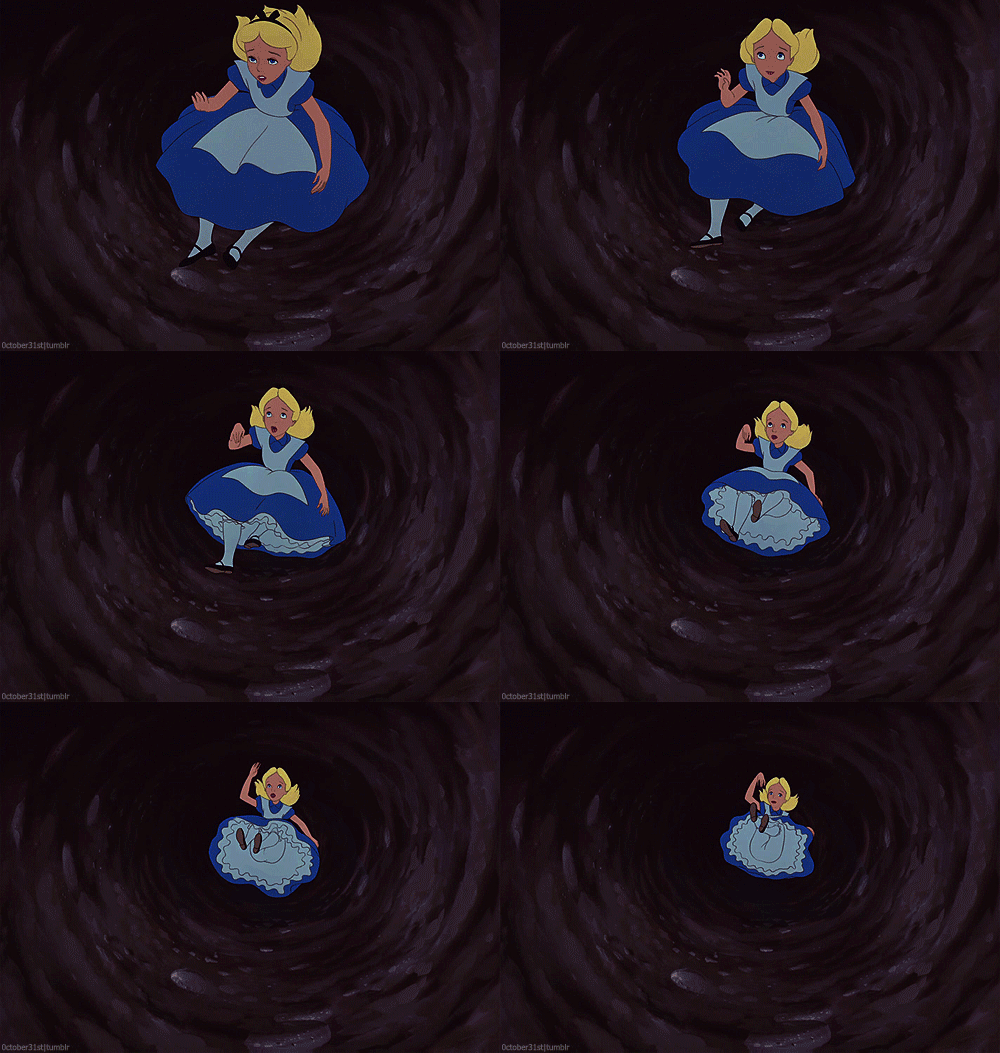
 Alice in Wonderland down the rabbit hole.

This has been my experience with a recent fragment of country house history– a relatively small part of the interminable PhD effort– one that keeps drawing me back, and each time, revealing something new. This fragment was initially the subject of a small conference paper on the relationship between servants and objects in the Victorian country house, and, unable to let me go, has morphed into a full-length article on objects as sites of memory, and the vagaries of servant memoirs.

Let me show you the fragment, as it first appeared to me.


What Gorst might have looked like, polishing the silver and how Gorst might have looked, in his footman’s livery).

In his memoir, Of Carriages and Kings, Victorian servant Frederick Gorst recounts a little of his time at Court Hey, the country house of Richard and Walter Gladstone, nephews of the four-times prime minister, William Gladstone. Gorst was especially reflective, for a footman, often impressed by a sense of ‘handling history,’ and, in the course of his duties, of being ‘allowed to glimpse, to touch for a moment, the lustrous past.’[1]


Surviving photograph of Court Hey, which was demolished in 1956.

One day, while cleaning the unused family silver that sat tarnishing in the vault, one item caught his eye. It was ‘an exquisite silver and gold vase about three feet tall… a copy of the famous Warwick vase,’ and had been ‘a legacy of Mr. Robertson Gladstone to his sons.’[2] (Gorst’s employers).


What the Gladstone Vase might have looked like. (This is actually a set of wine coolers in the same design, that was owned by the family).


Mr. Robertson, as the story goes, had been given the vase as a thank you present from the merchants of Liverpool, in ‘recognition of his munificent and timely gift’ of money to the starving workers and mill hands in the city. Why were they starving? The year was 1833, and slavery had just been abolished. There was now no sugar coming into the once-busy port, and ‘thousands of workers were idle and starving.’[3] However, the apparent generosity of Robertson Gladstone is clouded by one rather uncomfortable fact: his fortune came from the Gladstone family sugar plantations in Demerara… and the slaves who were forced to work there.  


1835 Abolitionist poster


The Gladstone family’s opposition to slavery was a source of some consternation to Gorst, who offers a strangely misleading account of their involvement in the matter. This deception has been the focus of my enquiry, but first, I investigated the vase, and its many historical connections and reincarnations.

It is an interesting case of an object possessing manifold cultural associations: the vase was not just a symbol of Britain’s participation in slavery, but is an exact replica of the Warwick Vase, which is linked to key figures of the late eighteenth century, and Britain’s diplomatic and classical past.

Dated to the 2nd century AD, the original Warwick vase was discovered by a Scottish painter, Gavin Hamilton, in the ruins of Hadrian’s Villa at Tivoli, and sold to Sir William Hamilton, a British diplomat. Sir William was an obsessive classicist who amassed large collections of vases, and, in the tradition of the ‘Grand Tour’, smuggled many back to England, despite an embargo on exporting antiquities (cough, Elgin marbles, cough).


Engraving of the ‘famous Warwick Vase.’

It is faintly ironic that the most famous of Hamilton’s vases bears the name of another collector. Having attempted, and failed, to sell it, Hamilton passed the job onto his nephew, Charles Greville, who was the younger son of the old Earl of Warwick (Hamilton’s brother-in-law). Greville made valiant, repeated attempts to carry off the deal, but he was not successful, and in the end, he sold it to his older brother, the Earl of Warwick, after whom it has been called ever since.


The Grevillea: named after Charles Greville.

Charles Greville is an interesting character (not least because the native Australian ‘grevillea’ plant was named after him- trust me, it’s exciting if you like gardening…). However, his rather more spectacular claim to fame comes through his mistress, a young woman called Emma Hart. Greville, who needed to find and marry a wealthy heiress, palmed Emma off on Hamilton, who took her to Naples as his mistress, and eventually married her there, after a five-year relationship. It was during their time in Naples that Lady Emma Hamilton (sound familiar yet?) met Lord Nelson, and the rest, as they say, was history.


Emma and Nelson: Britain’s favourite Napoleonic romance.

‘Take Lord Nelson with one limb,
Lady William Hamilton she fell for him,
With one eye and one arm gone west,
She ran like the devil and she grabbed the rest.
If women like that like men like those,
Why don’t women like me?’
(George Formby) 
.
And so, we circle back to Frederick Gorst, and his silver vase. It is possible to see how a single piece of silver, locked away in a cupboard, polished by a pensive footman at the end of the Victorian era, can take us right back through some of the more significant events of the preceding century. We have an object that is invested with historical meaning, that is linked to one of Queen Victoria’s prime-ministers, the Gladstone family’s role in the abolition (and support) of slavery, to England’s presence in the Mediterranean at the end of the eighteenth century, to their infamous habit of acquiring antiquities, and Britain’s favourite, Napoleonic romance.

At a quick scroll through, the flow of images in this post seem entirely disconnected– but they are not. They highlight the fact that, whenever you read about history, you will find moments of interconnectedness, association, and those wonderful flashes of ‘Well I never…’ Of course, if you’re feeling worn out and fed up with serious research, you can always do the same thing on Wikipedia for an hour or three… I highly recommend it.


[1] Gorst, 73
[2] Gorst, 71
[3] Gorst, 72

Sunday, 1 May 2016

Telegrams and Tools – Discovering the stories of family through objects.

By Ellen O'Brien - “PhD student, book lover and tea addict, I spend my days researching and writing, with help from my bunny George. History is not quite so visible in Australia as in England… but it's there if you know where to look!”

I sat for a moment in her chair, and let the dust settle. It was cool in the house, but out in the shed I could hear Mum and Tom wrestling with four decades of accumulated dust and debris. I wondered if Rose was somewhere nearby, watching us dismantle her home of fifty years? Sitting in the silence of the front room– it still retained the air of pristine sanctity that she maintained all her life– I thought that perhaps she wouldn’t mind. There was nothing mercenary about our sorting through her possessions, no siblings squabbling over jewellery (her frugal life didn’t allow for any), or the irreverence of a removal company.

© Ellen O'Brien
It is interesting to consider a life through objects, don’t you think? From a scientific perspective, they reveal things about a person or society. To an archaeologist, a fragment of pottery is as a good as a page from someone’s cookbook, or a weather report! Certainly, objects have informed my own understanding of history: ancient Egypt, to me, looks like the sarcophagi in the British Museum. But on a more intimate level, they are the mementoes we have collected on our way through life and chosen to keep around us, to look at, to touch, to remember everyday. What do these objects reveal about a person, and the joys and tragedies they have experienced? When Rose died, some of her possessions had an obvious significance– others only made sense because of the stories she told. Objects can tell us so much about the recently departed, but they also invite us into the lives of an entire family and extended family. This is what I recently experienced. That week, through the objects left in Rose’s house, we were able to trace my own family’s journey, from the harsh and isolated wheatbelt town of Kellerberrin, to the fringes of Perth in the 1960s, to London in the present day.

Allow me to explain. My father and his cousin Tom grew up a mere 127 kilometres apart in the towns of Corrigin and Kellberrin– pretty close by Australian wheatbelt standards– but didn’t actually meet until the 1990s, when Tom brought his small, English children to Australia for the first time. Somewhere in the depths of our family history, lies a dispute between brothers Patrick, my grandfather, and Connor, Roses’ husband and Tom’s Dad. It was tied up with the family farm at Kellerberrin, and which of the boys would inherit… we think. Rose, for many years the only remaining witness, was renowned for her ability to talk the leg off a chair, but was always uncharacteristically tight lipped about the matter. When Tom returned to Perth with his children in the 90s, they found some ready-made playmates in my brother and I, and more importantly, that no memory of this family feud existed. Perhaps Rose did us a great favour by keeping mum all those years, for Amy and I are now the best of friends, and in that peculiar way families have, have discovered that although we live 9000-odd miles apart, we have a great many things in common.  

© Ellen O'Brien
This is how I ended up, one warm January arvo, in Rose’s shed. Chock-a-block with oilcans and newspapers from the 70s, it was there we found Connor’s old tools. Thick with rust, they were clearly straight off the farm: the average suburban gardener doesn’t have much use for a plough chisel, or a set of imperial measurement spanners. Hanging on the wall was an old horse bit attached to a decaying bridle. Green with age, Tom extricated it from its cradle of spider webs. ‘That must have been the old horse’s… they kept him at the farm after motorised tractors came in… I remember Mum talking about him.’

© Ellen O'Brien

A self-confessed bibliophile, I found that I was drawn to the bookshelf in the ‘good room.’ The ubiquitous gold-edged Reader’s Digest titles were interspersed with some more telling items: Simone de Beauvoirs The Second Sex, surprising, perhaps, for a staunchly Catholic widow, and a collection of medical books, Yourself and Your Body, The Home Physician and A Husband’s Guide to Marriage. Were they a throwback to Rose’s nursing days, or an effort to negotiate what was by all accounts a difficult marriage in the lonely climate of the 1950s and 60s?

© Ellen O'Brien
In spite of these difficulties, there was evidence of female friendship. We unearthed a box of telegrams received on the birth of Tom in 1956, all written on identical General Post Office baby telegram forms, decorated with balloons and a teddy bear. ‘Congratulations on the birth of a darling baby boy, Love Patrick and Marjorie,’ read one in my grandmother’s handwriting. They were both, after all, raising boys in the austere conditions of a 1950’s farming community. With undertones of shared experience and affection, the note quietly acknowledges the negotiation of family ties and the lifestyle they shared.

That first day, Tom told us about his adventures in Africa, where he met Jane, the mother of his children. The ordinance maps and 78” records in his well-preserved teenage bedroom told the story of his diploma in surveying, his fascination with Perth’s growing music scene in the 80s, and his eventual escape to Notting Hill, Africa, Europe and finally, Milton Keynes. His tiny school hat –Aquinas College– was discarded as a symbol of the religion of his parents, rejected utterly by Tom after his experiences at the prestigious but close-minded boys’ school.

© Ellen O'Brien
Wrapped in newspaper like a piece of battered cod, in a box under my own bed, is a set of art deco teacups, which I hope one day will grace the bridal tea or house-warming party of my cousin Amy, who resembles her grandmother Rose in both waif-like build and resilience of mind and opinion. Our family has come full circle, from the strife over a dusty paddock in Kellerberrin, to enduring international friendship that has bloomed through the days of letter writing, to email, to Facebook and Snapchat.

In our week in Rose’s house, I learned about history through objects. It struck me as a shame that many of the stories were lost, and all we had left were these physical fragments and our own speculations. At risk of sounding like a community public service announcement, it is so important to connect with the older members of your family.  Ask, and let and them pass you their memories with their own weathered hands. After all, the real value of an heirloom is the story attached to it. Rose’s old Singer Sewing machine, now in my own mum’s expert care, was built in Strathclyde in 1949. It’s a beautiful piece of machinery, and surprisingly still works. But where did Rose get it? Was it a gift? Did she make her wedding dress with it? Either way, we have started making new memories with it. I can tell my children how, not knowing what it was, I tried to get the lid of with a rusty screwdriver, which gave way before the lid did. Or that a few mornings ago, our friend Peter hopped down the driveway (yes, he had a broken foot) and tested the motor by grabbing the edge of the sink and sticking a spanner in the socket. Electrical engineering at its finest (ahem). What about the women in Strathclyde who worked at the Singer factory? Wouldn’t it be wonderful to know what they were doing in 1949? For many, German bombs had decimated their homes just eight years previously, yet they were able to make these beautiful, intricate machines that travelled to the other side of the world. Such an unobtrusive little device, sitting quietly under its lid on the table, but what stories it could tell.