One of the great things about doing a collaborative PhD are the opportunities to get involved with the events and schemes that my partner institution runs. Last week this included having the opportunity to write a blog for the Natural History Museum as part of #ExploreArchives - the blog being based upon some of the research I've recently been doing which revealed the interesting tale of the purchase and arrival of a sea elephant to the Tring Museum.
So this is perhaps slightly cheating but as it ties into this months theme of Natural History here is the link!
https://blog.nhm.ac.uk/2016/11/25/the-day-the-sea-elephant-came-through-the-roof-explore-your-archive-week-library-and-archives/#more-6677
It's also worth having a poke around at some of the other recent blogs which showcase some of the really interesting things that can be uncovered within the archive - Enjoy!
Showing posts with label Natural History. Show all posts
Showing posts with label Natural History. Show all posts
Tuesday, 29 November 2016

Sunday, 13 November 2016
The Bauer Brothers: Masters of Scientific Illustration
To continue with a favourite theme of this blog I turn again
to the topic of natural history and in particular The Bauer Brothers exhibition that has been on display in the Images
of Nature Gallery at the Natural History Museum since November 2015.
 |
| Erica massoni L.f., 1796-1803 https://commons.wikimedia.org/wiki/File:Erica_massoni00.jpg |
The exhibition features the botanical and zoological
artworks of two exceptional natural history artists, Franz (1758-1840) and
Ferdinand (1760-1826) Bauer; Austrian born brothers who were educated by some
of the Continent’s most influential botanical artists of the time. You might be
thinking, “oh here she goes again reviewing yet another exhibition” and yes
that’s true. I can’t deny that that is what I’m going to do. But what I really like
about this exhibition and why I wanted to blog about it is because I was so
surprised by how taken I was with it, both in terms of content and concept.
Both brothers spent their entire lives studying and drawing
nature and the results are some truly beautiful and, I’m reliably informed,
scientifically accurate pieces of illustration. To quote the exhibition
website, the brothers ‘excelled in
learning the principles of botanical illustration according to the Linnaean
system of classification. This technique typically depicts the entire plant in
flower, but separately represents the bud and fruit, often dissected to show
the internal structure’(1). They are really fascinating pieces of art to stand
and look at, and even more so when you consider the degree of accuracy.
But behind the obvious skill both men had, I was also taken
by the stories of them as individuals. They had similar artistic styles and yet
their careers were very different from each other. Franz had been hired by Sir
Joseph Banks as the first resident artist at the Royal Botanic Gardens, Kew, in
London. While Ferdinand had been hired by Banks as the natural history artist
on the HMS Investigator (1801-1805) on its expedition to Australia. There he
worked alongside Robert Brown and made many sketches, which he bought back and
based future water colours on.
They are really beautiful pieces artwork – the colours
surprisingly bold and the level of detail just amazing. I rather naively
wouldn’t have expected scientific illustration of this period to have been of
such a high standard. It really was a pleasant surprise and when in the museum
I always like to wander past and take a look, especially as the drawings and
watercolours rotate every four months.
Beyond being aesthetically pleasing, what I also think is
great about this exhibition is how it highlights the depth of the Natural
History Museum’s collections, especially those of the Library and Archives. By
having this designated gallery, which shows exhibitions on a rotating basis,
Library staff are given the opportunity to delve into the archive and special
collections to bring to light something a bit different; something that isn’t a
piece of taxidermy or a slice of science. It can really remind us as visitors
that the value of the collections for research goes beyond science and can
reveal the history of the people involved in making the museum and its
collections. I’ve made clear elsewhere that I’m a huge fan of this approach and
I was really pleased to discover that there is at least one place within the
museum, designated to informing the public about an aspect of the history of
its collections.
You can find more info about the exhibition, which runs
until February 2017 here - http://www.nhm.ac.uk/visit/whats-on/programs/nhm/bauer_brothers_art_exhibition.html
(1) http://www.nhm.ac.uk/our-science/departments-and-staff/library-and-archives/collections/bauer-brothers.html
Sunday, 24 July 2016
The Rothschild Room...
and some thoughts on Natural History Museum's.
Hands up, this blog is going to be a little self-indulgent
but I wanted to share it with you because I think it’s a fantastic example of
what natural history museums should be doing, and that’s explaining their
history, the history of their collections and the history of those involved in
acquiring those collections.
The Rothschild Room at the Natural History Museum at Tring
was re-opened last year after a period of closure allowing for refurbishment
and I have to admit to being a huge fan. What I love about the room is how it
has taken the history of the museum and its founder, Walter Rothschild, and explained
to the public that history, and the context in which its natural history
collections were assembled throughout the 19th and 20th
centuries.
 |
| Panorama of the Rothschild Room at Tring Museum © Elle Larsson |
By showcasing key stories, specimens and individuals in a
highly accessible way, you leave the museum feeling like you’ve learnt a lot
more than you might have just by looking at specimens; because as a passive
observer and at a very basic level, that is all you are really doing when you
visit a natural history museum. They are odd testimonials to a bygone era whose
original public purpose has largely been usurped by television documentaries,
zoological parks and the internet.
 |
| Interactive Map showing Rothschild Collectors © Elle Larsson |
The Rothschild room contains a display that tells you about the key
people – Rothschild, his curators and family, as well as important collectors,
who you can find out more information about on an interactive map. There are photo
displays that show family photos and those of the animals Rothschild used to keep, as well as
touchscreens which allow you to look at some of the books produced by those at Tring and
that have since been digitised. It also includes taxidermy specimens to explain
some of Rothschild’s favourite species, artefacts on loan from other
collections and in the middle of the room there is a replica giant tortoise,
similar to the one Rothschild is famously photographed sitting on. It’s been completed
to a really high standard and implements many of the more successful modern
exhibition techniques. It was really refreshing to see the first time and remains
so, hence me choosing to blog about it.
 |
| Rothschild Room incorporates specimens and history © Elle Larsson |
I think what really stood out for me though is that this
isn’t an approach that many museums have adopted, particularly the larger
natural history museums. I understand that their purpose is to showcase
biodiversity and that the important scientific work that natural history
museums continue to do is going on behind the scenes, and, showcasing that, as
the Natural History Museum at South Kensington have done in building the
cocoon which allows the public to see into the scientific laboratories is a
good thing and only adds to visitor experience and understanding. They are hugely important and the work being done by them is hugely
significant. I just think there is scope in the public galleries to offer a
stronger narrative, one that perhaps merges science with history, drawing on the extensive historic collections these museums possess and doesn’t
just present a display case of zebras for someone to look at. As it stands we might
learn the Latin name for the species or be able to view them in their taxonomic
groups but what about the process of how and why they ended up there in the
first place? It might be an uncomfortable truth to confront but I think it is
an important one, especially in light of current concerns over conservation.
 |
| Digitised family photo albums © Elle Larsson |
I readily admit to having a personal interest in this and
the more I conduct my PhD research the more I realise the people who are working
on natural history collections also have interest in where these specimens
originally came from and how they ended up being in a museum collection – so
why is this not translating into display? There are spectacular stories to be told
and yet they’re not and I think that’s a real shame. It could dramatically
change the way in which people engage with natural history museums and that is
worth exploring in my opinion. There are some exceptions where this is
beginning to be done to a degree. The Horniman Museum and Gardens for example has
an introduction to their natural history gallery where they “set the scene” and
answer some of the key questions or draw attention to key debates - the fur and
feather trade for example and the history of its founder Frederick John
Horniman and how he acquired his collection. So I suppose change is on the
horizon. Perhaps I just need to exercise some patience and hope that in time,
more museums choose to adopt a similar approach to that undertaken by the Tring
Museum in their redesign of the Rothschild Room - it is fantastic and well worth a visit!
 |
| One of Rothschild's favourites - take a pic next time you're there! © Elle Larsson |
Sunday, 3 July 2016
Dinosaurs at the Natural History Museum, London - Circa 1881
Richard Fallon, PhD
Researcher at the University of Leicester and Centre for Arts and Humanities
Research, Natural History Museum, London.
I spend a lot of my time trying to
recapture the ways in which Britons around the turn of the century learnt about
prehistoric animals, in particular dinosaurs, and so it’s very useful to know
what visitors back then were actually looking at in their museums. Luckily,
visitors to the Natural History Museum (NHM) in South Kensington, which opened
in 1881, were able to purchase guidebooks that show us the exact layout of the old
galleries.
 |
As a Victorian, you would have seen nothing like this.
|

Anyone who’s been to the NHM lately
might reasonably expect that Victorians and Edwardians turned left at the entrance
and entered the big west Dino Gallery, just as we do today. But if you had done
that back then, you’d have actually entered one of the world’s largest collections
of stuffed birds. In fact, the entire west side of the building was dedicated
to modern skeletons and taxidermy.
How about the east gallery? Now it’s the
gift-shop, but back then it was actually the Gallery of Fossil Mammalia, lined
all the way down with austere cabinets and with a proud central row of the
Museum’s most complete mounted fossils: the famous Mastodon, a mammoth skull,
the Irish deer—just to name the most prominent items. The shady pavilion at the
far end brought visitors to South America, whose iconic Megatherium loomed menacingly over them. Around the edges of the
pavilion lurked the fossil birds, such as the various moas and the priceless Archæopteryx macrura.
 |
The sensational femur of Atlantosaurus.
|
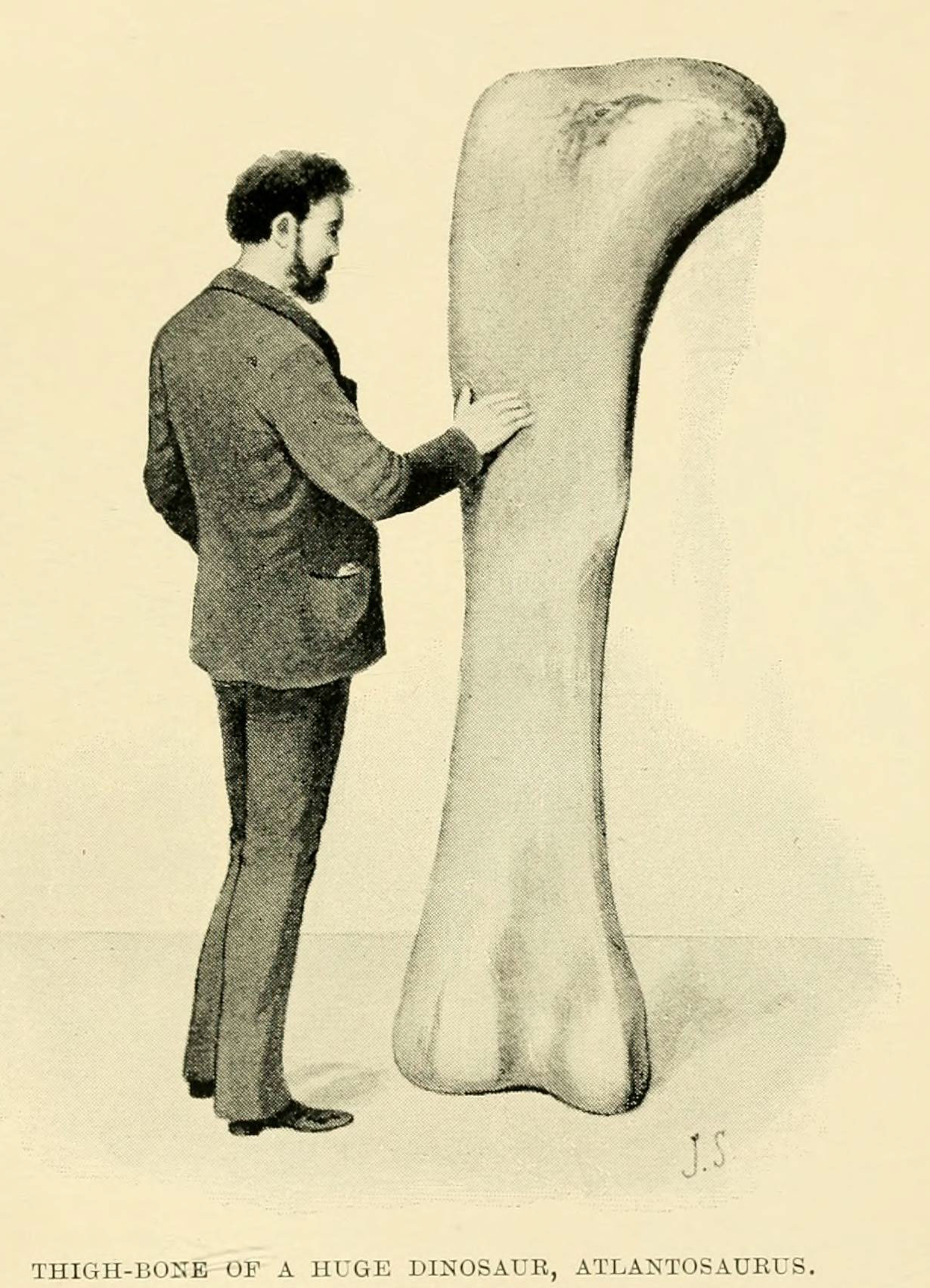
You’ve probably deduced by now
that dinosaurs were far from the main
attraction of the Museum in 1881, or 1891 and 1901, for that matter. Their home
was the eastern Gallery of Fossil Reptilia, a bit of a corridor and one of the
few areas of the museum that has changed very little since 1881. The walls were
still lined with those prize saurians, Ichthyosauri and Plesiosauri, but the various
fragments of dinosaur that were on
display were hardly complete enough to articulate and mount. Instead, they languished
in cabinets and waist-high table-cases. The impressively massive thigh-bone of
the American Atlantosaurus, of which
a cast arrived a few years after the Museum’s opening, constituted one of the very best relics on show.
As one commentator observed,
visitors often ‘pass hastily by the cases of bones, teeth, and skeletons’,
preferring instead
‘the more attractive collection of stuffed birds on the other side’. How times
have changed.
 |
Composite photo of the worldly remains of Cetiosaurus leedsi
|

In the subsequent decades, the dusty
cases of the Gallery of Fossil Reptilia were swept to the walls and the
corridor was gradually filled with more striking mounted, suspended, and articulated
fossils of the sort museumgoers expect today. It was still a slow process. You
have to feel a little sorry for Cetiosaurus
leedsi, the dilapidated but very British dinosaur that arrived in 1903,
only to be outshone by the world-famous cast of Diplodocus carnegii that was placed in the Museum two years later.
The Diplodocus was so big that it had
to be placed in the west side, with the modern reptiles, and it was quickly joined
by casts of Triceratops and a
relocated Iguanodon. The age of the
dinosaur museum was beginning.
The Natural History Museum’s
original collections are so scattered that you can quite easily come across
something unexpected when wandering around there today. The cautious and
systematic Victorian arrangement has been thoroughly jumbled, but it’s still
interesting to think about the ghost of the old plan as you look around. I’ll
tell you one thing, though: there are a heck of a lot fewer stuffed birds on
show there today.
Monday, 15 February 2016
Walter Rothschild & Cambridge
 |
| Lionel Walter Rothschild (1868-1937) https://commons.wikimedia.org/wiki/File:Walter_Rothschild.jpg |
As mentioned in a previous post, I spent a few days in Cambridge back in January and in between sessions had some time on my hands were I went exploring. Now the appeal for me was that Walter Rothschild, whose zoological work I’m focusing on for my PhD, attended Magdalene College, Cambridge from 1887 to 1889. So while I was there I thought I would take some time to visit the college and perhaps get a sense of where he was studying. Admittedly it’s hugely different now, but I think there is a lot to be said for a sense of place and if nothing else, I was curious.
I had some idea about his time at Cambridge from reading his
biography. We know he studied the Natural Science Tripos and was taught by
Alfred Newton, and for the last few months I’ve been trying to get a sense of
what it meant to be studying natural history/ biology at this time. It’s
reading I’ve found fascinating, but actually it was nice to put the books aside
for an hour and just soak up the atmosphere and have a bit of a wander.
 |
| Inner Courtyard of Magdalene College |
In contrast to some of the other colleges, Magdalene seemed
quiet and low key, it was slightly on the edge of the city and didn’t perhaps
have the grandeur I experienced when wandering around a couple of the others.
But there was something about Cambridge, it struck me as being a great place to
study and I wondered if Rothschild felt the same.
 |
| Dining Hall of Magdalene College |
I’m afraid I can’t tell you much more about his time at
Cambridge right now, but that little bit of exploring I did sparked off a few
questions that I’m eager to follow up as things move forward. Either that or
it’s just another excuse to go back!
Subscribe to:
Posts (Atom)