Showing posts with label blog. Show all posts

Sunday, 20 August 2017

Down the Rabbit Hole: Frederick Gorst and the ‘Gladstone Vase’

By Ellen O'Brien - “PhD student, book lover and tea addict, I spend my days researching and writing, with help from my bunny George. History is not quite so visible in Australia as in England… but it's there if you know where to look!”

Studying history can be a lot like late-night-procrasti-searching through the labyrinthine corridors of Wikipedia… you start with something fairly innocuous– a country house servant and a silver vase, for example– but one clue leads to another, and before you know it, you’re so far down the rabbit hole, you need a small crane and a search and rescue team to bring you back up.
 Alice in Wonderland down the rabbit hole.

This has been my experience with a recent fragment of country house history– a relatively small part of the interminable PhD effort– one that keeps drawing me back, and each time, revealing something new. This fragment was initially the subject of a small conference paper on the relationship between servants and objects in the Victorian country house, and, unable to let me go, has morphed into a full-length article on objects as sites of memory, and the vagaries of servant memoirs.

Let me show you the fragment, as it first appeared to me.


What Gorst might have looked like, polishing the silver and how Gorst might have looked, in his footman’s livery).

In his memoir, Of Carriages and Kings, Victorian servant Frederick Gorst recounts a little of his time at Court Hey, the country house of Richard and Walter Gladstone, nephews of the four-times prime minister, William Gladstone. Gorst was especially reflective, for a footman, often impressed by a sense of ‘handling history,’ and, in the course of his duties, of being ‘allowed to glimpse, to touch for a moment, the lustrous past.’[1]


Surviving photograph of Court Hey, which was demolished in 1956.

One day, while cleaning the unused family silver that sat tarnishing in the vault, one item caught his eye. It was ‘an exquisite silver and gold vase about three feet tall… a copy of the famous Warwick vase,’ and had been ‘a legacy of Mr. Robertson Gladstone to his sons.’[2] (Gorst’s employers).


What the Gladstone Vase might have looked like. (This is actually a set of wine coolers in the same design, that was owned by the family).


Mr. Robertson, as the story goes, had been given the vase as a thank you present from the merchants of Liverpool, in ‘recognition of his munificent and timely gift’ of money to the starving workers and mill hands in the city. Why were they starving? The year was 1833, and slavery had just been abolished. There was now no sugar coming into the once-busy port, and ‘thousands of workers were idle and starving.’[3] However, the apparent generosity of Robertson Gladstone is clouded by one rather uncomfortable fact: his fortune came from the Gladstone family sugar plantations in Demerara… and the slaves who were forced to work there.  


1835 Abolitionist poster


The Gladstone family’s opposition to slavery was a source of some consternation to Gorst, who offers a strangely misleading account of their involvement in the matter. This deception has been the focus of my enquiry, but first, I investigated the vase, and its many historical connections and reincarnations.

It is an interesting case of an object possessing manifold cultural associations: the vase was not just a symbol of Britain’s participation in slavery, but is an exact replica of the Warwick Vase, which is linked to key figures of the late eighteenth century, and Britain’s diplomatic and classical past.

Dated to the 2nd century AD, the original Warwick vase was discovered by a Scottish painter, Gavin Hamilton, in the ruins of Hadrian’s Villa at Tivoli, and sold to Sir William Hamilton, a British diplomat. Sir William was an obsessive classicist who amassed large collections of vases, and, in the tradition of the ‘Grand Tour’, smuggled many back to England, despite an embargo on exporting antiquities (cough, Elgin marbles, cough).


Engraving of the ‘famous Warwick Vase.’

It is faintly ironic that the most famous of Hamilton’s vases bears the name of another collector. Having attempted, and failed, to sell it, Hamilton passed the job onto his nephew, Charles Greville, who was the younger son of the old Earl of Warwick (Hamilton’s brother-in-law). Greville made valiant, repeated attempts to carry off the deal, but he was not successful, and in the end, he sold it to his older brother, the Earl of Warwick, after whom it has been called ever since.


The Grevillea: named after Charles Greville.

Charles Greville is an interesting character (not least because the native Australian ‘grevillea’ plant was named after him- trust me, it’s exciting if you like gardening…). However, his rather more spectacular claim to fame comes through his mistress, a young woman called Emma Hart. Greville, who needed to find and marry a wealthy heiress, palmed Emma off on Hamilton, who took her to Naples as his mistress, and eventually married her there, after a five-year relationship. It was during their time in Naples that Lady Emma Hamilton (sound familiar yet?) met Lord Nelson, and the rest, as they say, was history.


Emma and Nelson: Britain’s favourite Napoleonic romance.

‘Take Lord Nelson with one limb,
Lady William Hamilton she fell for him,
With one eye and one arm gone west,
She ran like the devil and she grabbed the rest.
If women like that like men like those,
Why don’t women like me?’
(George Formby) 
.
And so, we circle back to Frederick Gorst, and his silver vase. It is possible to see how a single piece of silver, locked away in a cupboard, polished by a pensive footman at the end of the Victorian era, can take us right back through some of the more significant events of the preceding century. We have an object that is invested with historical meaning, that is linked to one of Queen Victoria’s prime-ministers, the Gladstone family’s role in the abolition (and support) of slavery, to England’s presence in the Mediterranean at the end of the eighteenth century, to their infamous habit of acquiring antiquities, and Britain’s favourite, Napoleonic romance.

At a quick scroll through, the flow of images in this post seem entirely disconnected– but they are not. They highlight the fact that, whenever you read about history, you will find moments of interconnectedness, association, and those wonderful flashes of ‘Well I never…’ Of course, if you’re feeling worn out and fed up with serious research, you can always do the same thing on Wikipedia for an hour or three… I highly recommend it.


[1] Gorst, 73
[2] Gorst, 71
[3] Gorst, 72

Tuesday, 29 November 2016

Tales of the Unexpected!

One of the great things about doing a collaborative PhD are the opportunities to get involved with the events and schemes that my partner institution runs. Last week this included having the opportunity to write a blog for the Natural History Museum as part of #ExploreArchives - the blog being based upon some of the research I've recently been doing which revealed the interesting tale of the purchase and arrival of a sea elephant to the Tring Museum. 

So this is perhaps slightly cheating but as it ties into this months theme of Natural History here is the link!

https://blog.nhm.ac.uk/2016/11/25/the-day-the-sea-elephant-came-through-the-roof-explore-your-archive-week-library-and-archives/#more-6677

It's also worth having a poke around at some of the other recent blogs which showcase some of the really interesting things that can be uncovered within the archive - Enjoy!

Monday, 20 June 2016

Medicine through Time: The Old Operating Theatre, London Bridge

The Old Operating Theatre, London Bridge
Heading up the 32 step, narrow, circular stone staircase, I was thinking to myself “are we in the right place?” It felt more reminiscent of exploring the tower of Oxford Castle or the spire of St. Peter’s Basicillia rather than heading up to a museum. But it was the right place, for hidden in the attic of St Thomas’s Church in Southwark, is the oldest surviving operating theatre in Europe, dating from 1822.

The operating theatre was originally part of St Thomas’s hospital but when in June 1862 the hospital moved from its original site in Southwark to make way for a railway line to Charing Cross, the theatre was sealed up; only to be rediscovered almost a hundred years later in 1956. After discovery it underwent a process of restoration and was finally opened to the public as a museum in 1962.

The Operating Theatre itself was exactly like all the images I remember seeing in my GCSE Medicine Through Time textbook. It was very simple and in a way, quite clinical, although only if we substitute modern metal for wood, a lot of wood (and we know that that is not the most practical material for constructing an operating theatre from!) But what struck me most while standing there, looking down on the replica operating table, was just how audience centred the experience seemed to be. 

There was more room for observers to watch the surgery than for the patients and surgeons operating. A sense of spectacle really came across. Now that might be a wrong deduction, perhaps the emphasis then was on education and that doctors learnt best by observing surgery first hand, but I can see why the term ‘theatre’ was perhaps adopted to describe the places in which surgery took place. It was a somewhat bizarre experience to then stand at the bottom and look up – this would have overlapped with the age before anaesthetics and antiseptics – I’d have been awake and when I looked up could have had a hundred pairs of eyes staring back at me. Needless to say, I think the whole thing would have been absolutely terrifying!

Alongside the Operating Theatre there is also a Herb Garret, which was used throughout the 18th and 19th centuries by the St. Thomas’ Hospital apothecaries to store herbs and make medicines. I’d been warned about the smell of this part and so was somewhat relieved that it wasn’t too overpowering on this occasion, for this section of the museum is like a treasure trove, brimming with every type of herb, spice or plant needed to produce medicines and herbal remedies to cure an array of ailments. There were also lots of original surgical instruments, apothecary’s equipment, medical books and papers. We even spied the remedies of Thomas Holloway – the man responsible for the creation of Royal Holloway!

The Herb Garret
This was my favourite bit it has to be said. It was like stepping back in time and it encouraged you to use more than one of your senses – always a bonus! You could touch (although not everything), see and smell so many different things. You could have a go at producing pills, weighing ingredients and put back together an anatomical model. It was a good balance – you should know by know how highly I rate interaction and a ‘sense of place’.

Making Pills
Herbs & Spices
So why visit somewhere that induces images of blood, guts and gore? I’m not a fan of hospitals and am pretty squeamish these days, so thinking about it, it’s a pretty odd subject around which to formulate a museum. But also there are the ethical implications of medical case histories and as such, the ability or inability to add a “voice” to the narrative that the museum can tell. And I think this was what was actually missing from the experience – a sense of people’s stories. I know it’s incredibly complicated to convey those sorts of histories but even the voices of doctors or of nurses, wardens or even students were what was really lacking for me and I think that’s what would have given it that little more punch. It was missing a hook for me, the type that comes through connecting to an individual.

All said and done I am really glad we visited – it’s one of those off the beaten track places in London which is definitely worth a visit. I also wish we’d gone as a school trip back in the day, as it would have no doubt brought the whole topic that much more to life! 


As an additional note, it was also interesting that we spied a Rothschild connection in the form of the Evelina Hospital for Sick Children which was originally opened in 1869 having been funded by Baron Ferdinand de Rothschild of Austria in memory of his wife Evelina who had died, along with their son, in childbirth.

Sunday, 5 June 2016

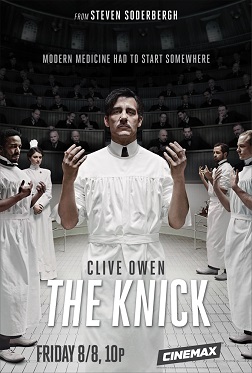
Just in 'The Knick' of time

By Tom Whitehead – “I work as a museum and education assistant. My main areas of interest are modern social and oral history, but more generally I'm interested in thinking about and exploring new ways in which we can engage diverse audiences with historical themes and topics they may not have previously considered. And Game of Thrones, I love Game of Thrones.” Check out Tom’s own blog here - https://tpdwhitehead.wordpress.com/

Promotional Poster
https://en.wikipedia.org/wiki/The_Knick
As someone who is both a historian, and one who enjoys lying in front of the television in a state of semi-conscious bliss, I’m always on the lookout for a good historical drama. In my mind the stick every historical drama should be measured by is Deadwood, a show that was cancelled criminally early and which remains, to this day, one of the finest pieces of television (and for that matter anything) I’ve watched.

Until fairly recently, I thought that the show which would finally topple Deadwood from its lofty perch would be Boardwalk Empire, a presumption primarily based on the fact that every television critic from Los Angeles to Littlehampton kept referring to it as “the new Deadwood”. But truth be told, Boardwalk never really captured me the way Deadwood did. Was it bad? No, far from it; but neither was it on a par with Deadwood, a show which managed to present a microcosm of frontier society in nineteenth century America in a way which explored some very important historical issues, whilst remaining grounded in the human story it was trying to tell.      

I never thought I’d find my new Deadwood, that is, until I started watching a programme called The Knick on Sky Atlantic. On the surface, the show is a medical drama about the Knickerbocker Hospital (or, as it’s more commonly known, simply ‘The Knick’), set in early twentieth century New York. However, watch it for more than ten minutes and you’ll soon realise there is so, so much more to the show than that description can ever hope to convey. There are only two series so far, and I hope beyond all hope they make a third season, because without doubt The Knick is as close to perfect as a historical drama can be.

On a purely televisual level the show is superb. It’s beautifully shot, it has a great soundtrack, the casting and characterisation are great across the board, and the production team have done a great job in creating a series of settings which feel historically authentic. As I argued in a post on my own blog a few years ago, to me historical accuracy is less important than historical authenticity. I have no idea if the clothes the cast are wearing are 100% accurate, or if the slang and idiom they’re using is genuine turn of the century New Yorker; and more to the point I don’t really care. I don’t care because what they’re wearing and saying feels accurate, and in terms of historical drama that, to me, is the thing which counts.

However, it is the way the show uses the medical procedural format to explore its historical context that I particularly like. Like with the costumes, I’m not sure if the medical history The Knick presents is entirely accurate, and there are some scenes and storylines which certainly seem to have taken great artistic licence with history. However, in this case I feel it is justified, as it is clear The Knick is using these more imaginative segments to expose its audience to nineteenth century attitudes towards medical issues such as abortion, contraception, addiction, and mental health, in a way which allows them to understand them but which isn’t unduly didactic. At no point when you’re watching The Knick do you ever feel like these issues are being forced into the narrative as a point of discussion. Rather they feel like a natural part of the narrative, and as such you find yourself thinking about them long after you’ve finished watching.

Indeed, for me the true triumph of The Knick is that the issues it explores go well beyond the operating theatre. The Knick does not shy away from exploring difficult social, ethical and political themes, and it would be hard to pick out just one or two key examples of this as the themes the show explores are all so tightly interwoven. However, if I had to pick out one grand ‘theme’ it would be inequality in all its guises. The Knick does a great job of showing how deeply divided New York was on racial, gender and socio-economic grounds, and more to the point it shows just how many people had a vested interest in it staying that way. As such, The Knick holds an uncomfortable mirror up to our presentday society, as whilst we have come a long way since the early 1900s, watching The Knick reminds us that the shadows of our collective past will continue to follow us for a long time yet to come.

Friday, 20 May 2016

The Crime Museum Uncovered: Tackling a Difficult History

“It was colonel mustard in the study with the candlestick” – crime is an embedded part of modern society. Not a day goes by when the news doesn’t report  a crime of some description, or a video game is released that allows players to steal cars (or worse), or thousands sit down to watch a peak time televised crime drama. It surrounds us and in many ways we’ve become somewhat desensitised to it as a society. Or at least that’s what I’d have previously argued until a visit to The Crime Museum Uncovered exhibition at the Museum of London a few months ago called that view into question. Unfortunately the exhibition has now ended but it raised some interesting questions for me about the challenges faced when putting an exhibition together.

Prior to the launch of this exhibition I had never heard of the Crime Museum and it would never have occurred to me that Scotland Yard would have their own museum and an artefact collection used for the training of new recruits. It’s not the usual function you associate with a museum is it really, although it feels somewhat obvious now it has been pointed out. Anyway, back in February we decided we’d visit and I have to say the very subject of the exhibition made me a little apprehensive about visiting. Crime. It is one thing to indulge in an episode of Criminal Minds or Shetland once a week, but it is something completely different to be physically confronted with remnants of crime; items once belonging to victims or perpetrators - murder weapons, newspaper reports and execution materials- the list goes on. The mind boggles around the ethical implications behind this exhibition, but my experience of Museum of London exhibitions has always been good and I was certainly intrigued to see what it had to offer on this occasion.

Free Museum Guide
The sheer popularity of this exhibition has been staggering; I was certainly not alone in my curiosity. And my first impressions were good, although I couldn’t decide if their choice of museum guide (a newspaper style document with headlines matching displays and giving descriptions of items within cases) was pure genius or downright distasteful. I’m still undecided, but then again the whole exhibition tapped into this idea that something so macabre can at the same time be so captivating – there is something quite disturbing to be said there about human nature when you think about it.

Anyway, back to the exhibition which was divided into three main sections. The first was mainly about the history of Crime Museum alongside some items from its collections. This included illustrations, a visitor book and museum catalogue, as well as death masks and prison records, which included mugshots. However, the items that still stick out for me from this section were the execution ropes in a case as you moved towards the second section of the exhibition. You were told about the individual who was hung from each rope and their crime, however, rather than recoil, I was left questioning how they could possibly know it was those exact ropes? I think if curators are going to make a claim like that it needs more explaining. Was it because records show which execution boxes (shown later on in the exhibition) are used for which cases in some sort of register, as we theorised? If that’s the case then that needed to be made clearer. Explain processes, especially if it is as something as simple as that, because our questioning took away from the impact those items had on us as visitors. And this also demonstrates what I mean about being desensitised to this sort of information, I was hung up on validity of evidence rather than the fact this rope had in part been responsible for taking someone’s life.

The second section of the exhibition broke into a large area, with specific case studies across the time span covered located down one side of the exhibition room, while along the other ,and at islands platforms in the centre, a more thematic approach was taken by showing a specific type of crime. For each case study the year was given, the offenders and their charge listed, and their victims named. Some crimes you knew, some you didn’t, but at this stage you really got a sense of the human story – of both the victim and of the perpetrator – that lay behind the exhibition.

Finally, at the end of the exhibition there was a room for reflection. A chance for you as a visitor to decompress on what you’d just seen but also to hear from those involved with the curation of the exhibition – their intentions, hopes and considerations in compiling, what was both a confronting and thought provoking exhibition. I was particularly struck by two comments made in the videos. The first was by one of the curators who said that ‘Museums shouldn’t be afraid to confront the uncomfortable’ and I couldn’t agree more. I also think the exhibition has been successful in doing this and has shown how it can be made possible. The second comment, and unfortunately I can’t exactly remember who made it, was that ‘Everyone is somebody to someone’ - a reflection on the ethical complications of putting this exhibition together. I still think it had been well done. It wasn’t overly emotional, nor was it cold and clinical. It’s taken a complicated history in which a number of groups, families and individuals are invested and presented it in such a way that visitors left not only knowing about particular crimes, but also about the history of policing and crime solving.

This is a poorly timed blog as the exhibition closed back in April but I just thought I would share my reflections on what was an unusually captivating exhibition by the Museum of London.

Sunday, 1 May 2016

Telegrams and Tools – Discovering the stories of family through objects.

By Ellen O'Brien - “PhD student, book lover and tea addict, I spend my days researching and writing, with help from my bunny George. History is not quite so visible in Australia as in England… but it's there if you know where to look!”

I sat for a moment in her chair, and let the dust settle. It was cool in the house, but out in the shed I could hear Mum and Tom wrestling with four decades of accumulated dust and debris. I wondered if Rose was somewhere nearby, watching us dismantle her home of fifty years? Sitting in the silence of the front room– it still retained the air of pristine sanctity that she maintained all her life– I thought that perhaps she wouldn’t mind. There was nothing mercenary about our sorting through her possessions, no siblings squabbling over jewellery (her frugal life didn’t allow for any), or the irreverence of a removal company.

© Ellen O'Brien
It is interesting to consider a life through objects, don’t you think? From a scientific perspective, they reveal things about a person or society. To an archaeologist, a fragment of pottery is as a good as a page from someone’s cookbook, or a weather report! Certainly, objects have informed my own understanding of history: ancient Egypt, to me, looks like the sarcophagi in the British Museum. But on a more intimate level, they are the mementoes we have collected on our way through life and chosen to keep around us, to look at, to touch, to remember everyday. What do these objects reveal about a person, and the joys and tragedies they have experienced? When Rose died, some of her possessions had an obvious significance– others only made sense because of the stories she told. Objects can tell us so much about the recently departed, but they also invite us into the lives of an entire family and extended family. This is what I recently experienced. That week, through the objects left in Rose’s house, we were able to trace my own family’s journey, from the harsh and isolated wheatbelt town of Kellerberrin, to the fringes of Perth in the 1960s, to London in the present day.

Allow me to explain. My father and his cousin Tom grew up a mere 127 kilometres apart in the towns of Corrigin and Kellberrin– pretty close by Australian wheatbelt standards– but didn’t actually meet until the 1990s, when Tom brought his small, English children to Australia for the first time. Somewhere in the depths of our family history, lies a dispute between brothers Patrick, my grandfather, and Connor, Roses’ husband and Tom’s Dad. It was tied up with the family farm at Kellerberrin, and which of the boys would inherit… we think. Rose, for many years the only remaining witness, was renowned for her ability to talk the leg off a chair, but was always uncharacteristically tight lipped about the matter. When Tom returned to Perth with his children in the 90s, they found some ready-made playmates in my brother and I, and more importantly, that no memory of this family feud existed. Perhaps Rose did us a great favour by keeping mum all those years, for Amy and I are now the best of friends, and in that peculiar way families have, have discovered that although we live 9000-odd miles apart, we have a great many things in common.  

© Ellen O'Brien
This is how I ended up, one warm January arvo, in Rose’s shed. Chock-a-block with oilcans and newspapers from the 70s, it was there we found Connor’s old tools. Thick with rust, they were clearly straight off the farm: the average suburban gardener doesn’t have much use for a plough chisel, or a set of imperial measurement spanners. Hanging on the wall was an old horse bit attached to a decaying bridle. Green with age, Tom extricated it from its cradle of spider webs. ‘That must have been the old horse’s… they kept him at the farm after motorised tractors came in… I remember Mum talking about him.’

© Ellen O'Brien

A self-confessed bibliophile, I found that I was drawn to the bookshelf in the ‘good room.’ The ubiquitous gold-edged Reader’s Digest titles were interspersed with some more telling items: Simone de Beauvoirs The Second Sex, surprising, perhaps, for a staunchly Catholic widow, and a collection of medical books, Yourself and Your Body, The Home Physician and A Husband’s Guide to Marriage. Were they a throwback to Rose’s nursing days, or an effort to negotiate what was by all accounts a difficult marriage in the lonely climate of the 1950s and 60s?

© Ellen O'Brien
In spite of these difficulties, there was evidence of female friendship. We unearthed a box of telegrams received on the birth of Tom in 1956, all written on identical General Post Office baby telegram forms, decorated with balloons and a teddy bear. ‘Congratulations on the birth of a darling baby boy, Love Patrick and Marjorie,’ read one in my grandmother’s handwriting. They were both, after all, raising boys in the austere conditions of a 1950’s farming community. With undertones of shared experience and affection, the note quietly acknowledges the negotiation of family ties and the lifestyle they shared.

That first day, Tom told us about his adventures in Africa, where he met Jane, the mother of his children. The ordinance maps and 78” records in his well-preserved teenage bedroom told the story of his diploma in surveying, his fascination with Perth’s growing music scene in the 80s, and his eventual escape to Notting Hill, Africa, Europe and finally, Milton Keynes. His tiny school hat –Aquinas College– was discarded as a symbol of the religion of his parents, rejected utterly by Tom after his experiences at the prestigious but close-minded boys’ school.

© Ellen O'Brien
Wrapped in newspaper like a piece of battered cod, in a box under my own bed, is a set of art deco teacups, which I hope one day will grace the bridal tea or house-warming party of my cousin Amy, who resembles her grandmother Rose in both waif-like build and resilience of mind and opinion. Our family has come full circle, from the strife over a dusty paddock in Kellerberrin, to enduring international friendship that has bloomed through the days of letter writing, to email, to Facebook and Snapchat.

In our week in Rose’s house, I learned about history through objects. It struck me as a shame that many of the stories were lost, and all we had left were these physical fragments and our own speculations. At risk of sounding like a community public service announcement, it is so important to connect with the older members of your family.  Ask, and let and them pass you their memories with their own weathered hands. After all, the real value of an heirloom is the story attached to it. Rose’s old Singer Sewing machine, now in my own mum’s expert care, was built in Strathclyde in 1949. It’s a beautiful piece of machinery, and surprisingly still works. But where did Rose get it? Was it a gift? Did she make her wedding dress with it? Either way, we have started making new memories with it. I can tell my children how, not knowing what it was, I tried to get the lid of with a rusty screwdriver, which gave way before the lid did. Or that a few mornings ago, our friend Peter hopped down the driveway (yes, he had a broken foot) and tested the motor by grabbing the edge of the sink and sticking a spanner in the socket. Electrical engineering at its finest (ahem). What about the women in Strathclyde who worked at the Singer factory? Wouldn’t it be wonderful to know what they were doing in 1949? For many, German bombs had decimated their homes just eight years previously, yet they were able to make these beautiful, intricate machines that travelled to the other side of the world. Such an unobtrusive little device, sitting quietly under its lid on the table, but what stories it could tell.

Wednesday, 23 December 2015

Christmas at Waddesdon Manor

Waddesdon Manor
Let’s call this the Christmas edition shall we as it is going to be Christmas themed!

A few weeks ago I paid a trip to Waddesdon Manor, together with the WI (I’m not a member, but it’s a rather long story!) in part because of its Christmas attractions but also because I hoped to learn a little about the wider Rothschild family and their home at Waddesdon Manor. However, there was a slight flaw in this plan, as Christmas was very much at the centre of everything and history seems to have been somewhat side lined.

It would appear that the draw for Waddesdon Manor at this time of year is Christmas and it becomes more of a place of entertainment than a typical National Trust property. It has a Christmas market, Christmas themed rooms with large decorated Christmas trees and a wonderful Christmas light show. But it completely takes over. It doesn’t sit alongside everything else and in some ways that was a bit of a shame. For example the Billiard room was turned into the three wise men’s camp with boxes of frankincense, myrrh and gold placed on the chaise-longue. It was cool, but at the same time gimmicky – I’d sort of expected the rooms of the Manor to be done as they would have been by the family at Christmas, rather than with this thematic spin.

Northern Lights inspired tree
Don’t get me wrong, it was great and it definitely put me in the mood for Christmas but the thing I struggled with was the lack of history on offer to read and learn from. Unless you knew that Waddesdon Manor was the home of Baron Ferdinand Rothschild you’d have been unlikely to pick that up anywhere and given that I’d hoped to find out more about them and their history this was slightly disappointing. I think I’ll have to revisit the house re-opens in the spring for a more typical visit.

However, in addition to the Christmassy bits, the Aviary was probably my favourite part. The Rothschild’s are known for being collectors and Ferdinand was fond of birds. There’s an information panel that informs visitors about the history of the Aviary - its establishment by Baron Ferdinand and the contributions of his sister, Alice, its decline during WW2 and finally it’s rejuvenation in the 1970s. It now houses several stud book managed species with a focus on preservation against extinction.

The Aviary


This includes the Rothschild’s Mynah and again an information panel explains how the bird was named after Walter Rothschild shortly after its discovery in 1910. Walter of course, having his own natural history collection not too far away at Tring. The same panel also describes how the Aviary team have been working with the Begawan Foundation and European zoos in an effort to save this critically endangered bird from extinction and I thought this was quite interesting as a reflection of how our attitudes and the priorities in managing the aviary have changed.
The Rothschild Mynah

The Rothschild’s Mynah is endemic to Bali – but because of its beauty it was illegally poached from the wild for the globe pet trade, prices peaking in 1990s at £1000 per bird!!! By 2001 the wild population was believed to be as low as 6 individuals and efforts since to reintroduce captive bred birds have had limited success. A more recent survey in 2012 counted 40 individuals and in order to promote genetic diversity Waddesdon’s Aviary have been involved in a cooperative breeding programme, with some of their birds being reintroduced to the wild and becoming parents themselves.

I have to admit I geeked out at this – the day offered history, Christmas and natural history. What more could this girl ask for? It wasn’t what I’d expected, but I think it’s definitely worth another visit when it reopens in the spring, with the hope that it will be more ‘typically’ National Trust and have some of the information I’m looking for!

Monday, 29 June 2015

The Subterranean Secret Lair of Britain’s Second World War Leaders.

The Cabinet War Rooms
It’s been a long, long time since I last went to the Churchill War Rooms but after numerous visits to London in recent months where I’ve walked past it and said “I really must go back there”, I finally got around to it. It’s the second recent visit I’ve made to a place affiliated with Winston Churchill in the past month; the first having of course been Blenheim Palace which was the feature of another recent blog, and it is perhaps rather apt given that this year marks the 50th anniversary of his death.

Having first become operational at the end of August 1939, it’s always struck me as a bit odd that the War Rooms remained largely intact immediately after the war, never having been fully dismantled or turned back into the stores and offices they had once been.  An odd view for a proponent of heritage to have perhaps, but also somewhat redundant as we know this didn’t happened.  It was as if someone knew how much of interest they would be in the future, for most of the important rooms have remained preserved and untouched for some 70 years since the end of the Second World War.


Visitor Feedback built into the exhibition
The War Room’s caretaker, Rance, stayed on post- war and after a 1948 press conference revealed the secrets of the Rooms, he began giving tours, enlightening visitors to what had once gone on there. This marked the beginning of a surge in interest in the War Rooms over the next thirty years, resulting in the Imperial War Museum being asked to restore the site and open it as a museum to the public, which it did in 1984. Ever since it’s commanded worldwide interest and remains a highly popular attraction with tourists visiting London – you only have to look at the admissions queue for evidence of this!

They may date from 1939, but it is under the leadership of Prime Minister Churchill, whose term in office began in 1940, that the War Rooms really began being used and with whom they will undoubtedly, forever be associated and remembered.  It was from these rooms that Churchill commanded the war effort of Britain and it’s Empire; held important meetings, as the Blitz raged on overhead; in which he contemplated and planned for the anticipated Nazi invasion; and into the adjacent map room that he brought some of his most important visitors to demonstrate the thorough and high-tech charting of the war. This subterranean network has some fascinating stories to tell, many of which are unveiled on a visit.

The War Rooms consist of a series of rooms connected by a network of narrow passages – what you’d expect really from an underground HQ. But as a visitor what this means is on a busy day it’s a bit claustrophobic and the day I visited, it was very, very busy. A lot of people were tripping over each other to get around and have a good look and I felt a bit harassed at the beginning, it has to be said. However, what I was immediately struck by was the sense of authenticity embodied here. The War Rooms really evoke the ‘sense of place’, that can really entice a visitor to connect with their experience.

Many of the rooms are still ‘dressed’ as they were left and it is like peering into a window in time. It’s not a museum in an abstract setting, the information being told here relates directly to events that went on within those exact rooms; that table is where the Cabinet met and made decisions, Churchill spoke on that telephone, and Mrs Churchill slept in that bed. These things are fact – ok they could be replicas - I’m pretty sure they weren’t but they could be - but you get my point. On the whole, this is a genuine piece of history, a snapshot in time, and in overhearing other visitors’ comments on this aspect; I would conclude that the War Rooms are successful in capturing interest on this very basis.

One of the Rooms occupied during the war
I was actually surprised at how much there was too see and how much has remained untouched; the map room being particularly impressive. The walls are still covered with wartime maps, each of which is punctuated by thousands of tiny pin holes, charting the movements of naval and military conveys across the world. There is even a key pinned to one wooden post providing an indication of which country is represented by each colour. It’s kind of eerie in a way, knowing that most of what occurred in the war would have been fed back into this very room. It sort of bought home the enormity of it all again, just in a different way.

One of the many maps still in situ.
In terms of transmitting information the War Rooms depend on visitors using an audio guide, each room having been designated a number which you then type in to hear the information. I was always a bit anti-audio guide, I much prefer making my own way around and not being dependent on a device to gain information, but in this context audio guides seem to be the best option. Realistically there is little space for information panels or guides and if there were, given how many people you’re battling your way around, I suspect they would be difficult to access and read. Having the audio guide means you can tuck yourself in a corner and have a listen at your convenience, either before, after, or while viewing the rooms it’s talking about. It’s also very helpful in finding your way around, signalling which way to go!


An artefact that particularly stood out for me was the map of Europe which proposed how Germany would be divided up in zones of occupation after the end of the war and which had been used by Churchill at the Potsdam Conference in July 1945. World War Two was the focus of most of my pre university history education in one way or another, so I knew at a conceptual level that this happened, but to see the actual map which had been drawn on, shaded in and annotated really bought it home.
What I hadn’t realised was that the War Rooms also contain the Churchill Museum, a dedicated sub-museum to the man some claim is ‘Britain’s greatest politician and historical figure’ (1) and I was very interested to read in the guidebook after my visit, the intention of this museum. Here’s the passage I found particularly insightful:

Winston Churchill, has become a two dimensional and slightly unreal character. His reputation rests largely on superficial knowledge, constantly replayed images and on one brief –albeit momentous – period of his life. The Churchill Museum has taken on the difficult task: a ‘personality museum’ could so easily slip into the pitfalls of dullness or hagiography. There was a clear need for a museum which could explore the complex nature of Churchill’s life and his long political career…

One they further outline would challenge the existing narrative and reveal aspects of his life and personality that were otherwise unknown or forgotten (2). And what a way to do it. The exhibition puts into perspective his whole life, focusing on five key areas; his childhood, early political career, ‘Wilderness years’, War Leader and Cold War Statesmen. And I have to say, I came away having learnt a great deal, because I too was guilty of having this ‘two dimensional’ view of Churchill that did only really concentrate on his role as a war time leader.

As you enter the Churchill Museum, the introductory panels explain at the outset how ‘This exhibition explores the real man behind the icon’, so early on you are being challenged to reconsider any existing knowledge you may already have. This was something my friend had mentioned to me when we were at Blenheim, and something she argued the War Rooms explored more directly than at the former. I just hadn’t realised how head on they really do deal with it. I dare say they could have taken it even further, but as it stands they have pushed those preconceived ideas we have as a society about Churchill, and even more impressively, have done so without alienating themselves from more traditional 'thinkers' in the process. I didn’t feel like the museum had ruined by perception of Churchill, just encouraged me to reconsider it and I did leave feeling as though I’d been given a more rounded perspective of him; one that included his odd habits and more controversial politics.

Interactive Screens challenge what you know or
understand about Churchill, in this case his views on the Empire
The use of touch screens was also particularly helpful in encouraging visitors to engage with this idea. Through this medium visitors are asked quite thought provoking questions about some of Churchill’s more controversial politics. For example, one screen poses the view ‘Churchill’s views on India were based on race’ and you’re invited to cast your vote (Strongly Disagree, Disagree, Not Sure, Agree or Strongly Agree). You’d then be offered access to further information - primary sources and research that you could read and continue to take further until you’re asked again if you'd like to reconsider your original response. Once you’ve made that decision you are then shown the rest of the results and can see what other visitors have thought when doing the same activity. I think it’s a really well done element, tackling something quite challenging. It wasn’t lecturing or pushing a view point on you. Each screen offered you further information upon which to draw your own conclusion – museum visitors doing their very own history - what can be better?!

A large interactive map provides the museum's 'centre-piece'
and allows visitors to interact with far more archive material than could
otherwise be displayed.
A display of personal family photos
and letters between Winston
and Clementine
The techniques used by the Churchill Museum are broad and varied across the space and offer visitors an experience which is something of an assault on the senses which I liked, but also found to be a bit over whelming. A high level of modern technology has been used to make it interactive. There were sound effects, video excerpts, photographs and objects; all exhibited in designated areas that focused on a particular period of his life, with each segment being centred on a large interactive table offering visitors a platform through which to engage with a more extensive range of the museums archive material about Churchill’s life and career. There is really a sense that the museum wants to project a rounded image of Churchill to the public, but also to arm them with as much material as possible to draw their own conclusions and move beyond this overriding image and understanding we have of him as the War Time leader.    

One of many interactive screens - this one picking out
Churchill's famous and lesser known quotes.
I have a vague memory of visiting the war rooms when I was younger but this recent visit has been really thought provoking and has really challenged my pre-existing understanding and knowledge of Winston Churchill. I think the Churchill War Rooms offer visitors a chance to engage dynamically with this area of history, offering a good balance of good ‘academic’ history, as provided by the Churchill Museum, and good ‘popular’ history, as provided by the War rooms. It was a great day out and one I would certainly recommend - I’m very glad I finally got around to spending my afternoon there!

P.S....

....There always seems to be a wild/exotic animal trade/gifting link in the unlikely of places! 
(1)    Churchill War Rooms Guidebook.
(2)   Churchill War Rooms Guidebook.