Showing posts with label history student. Show all posts

Sunday, 20 August 2017

Down the Rabbit Hole: Frederick Gorst and the ‘Gladstone Vase’

By Ellen O'Brien - “PhD student, book lover and tea addict, I spend my days researching and writing, with help from my bunny George. History is not quite so visible in Australia as in England… but it's there if you know where to look!”

Studying history can be a lot like late-night-procrasti-searching through the labyrinthine corridors of Wikipedia… you start with something fairly innocuous– a country house servant and a silver vase, for example– but one clue leads to another, and before you know it, you’re so far down the rabbit hole, you need a small crane and a search and rescue team to bring you back up.
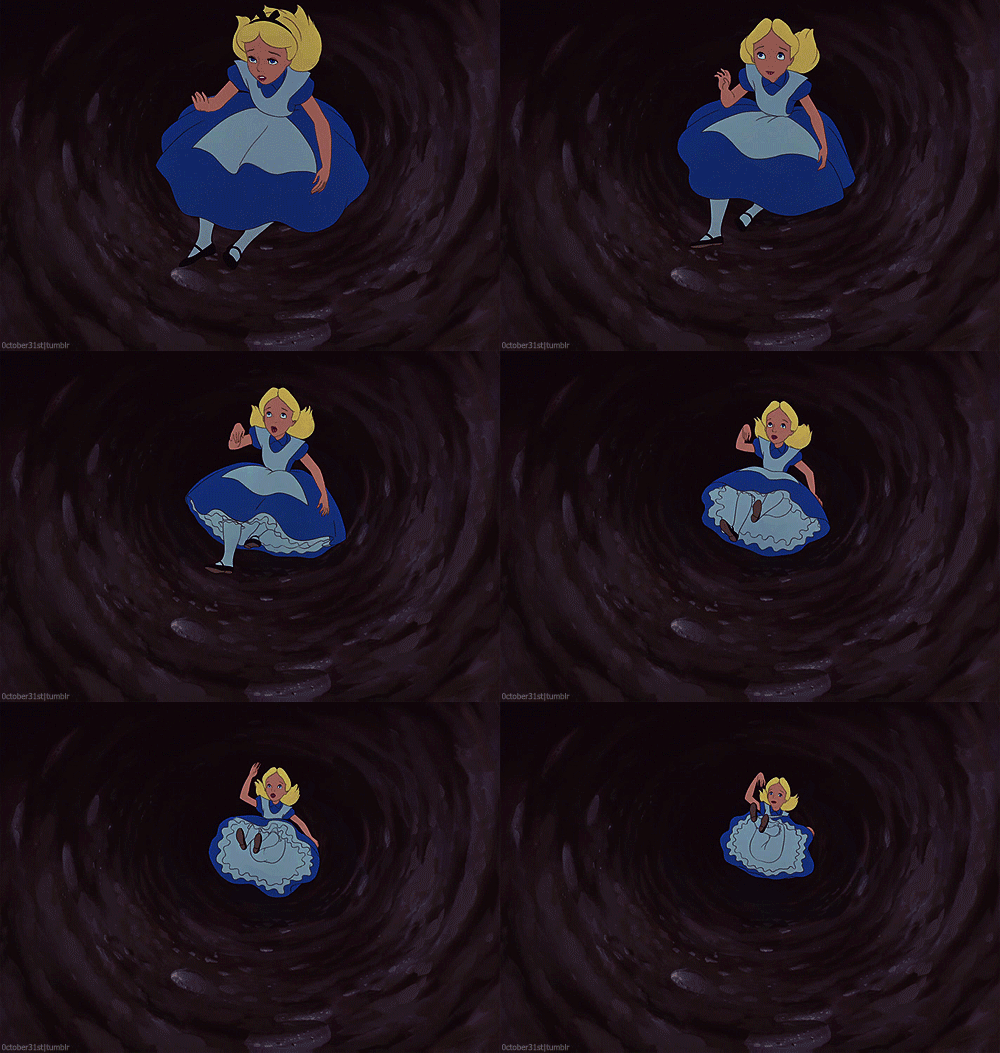
 Alice in Wonderland down the rabbit hole.

This has been my experience with a recent fragment of country house history– a relatively small part of the interminable PhD effort– one that keeps drawing me back, and each time, revealing something new. This fragment was initially the subject of a small conference paper on the relationship between servants and objects in the Victorian country house, and, unable to let me go, has morphed into a full-length article on objects as sites of memory, and the vagaries of servant memoirs.

Let me show you the fragment, as it first appeared to me.


What Gorst might have looked like, polishing the silver and how Gorst might have looked, in his footman’s livery).

In his memoir, Of Carriages and Kings, Victorian servant Frederick Gorst recounts a little of his time at Court Hey, the country house of Richard and Walter Gladstone, nephews of the four-times prime minister, William Gladstone. Gorst was especially reflective, for a footman, often impressed by a sense of ‘handling history,’ and, in the course of his duties, of being ‘allowed to glimpse, to touch for a moment, the lustrous past.’[1]


Surviving photograph of Court Hey, which was demolished in 1956.

One day, while cleaning the unused family silver that sat tarnishing in the vault, one item caught his eye. It was ‘an exquisite silver and gold vase about three feet tall… a copy of the famous Warwick vase,’ and had been ‘a legacy of Mr. Robertson Gladstone to his sons.’[2] (Gorst’s employers).


What the Gladstone Vase might have looked like. (This is actually a set of wine coolers in the same design, that was owned by the family).


Mr. Robertson, as the story goes, had been given the vase as a thank you present from the merchants of Liverpool, in ‘recognition of his munificent and timely gift’ of money to the starving workers and mill hands in the city. Why were they starving? The year was 1833, and slavery had just been abolished. There was now no sugar coming into the once-busy port, and ‘thousands of workers were idle and starving.’[3] However, the apparent generosity of Robertson Gladstone is clouded by one rather uncomfortable fact: his fortune came from the Gladstone family sugar plantations in Demerara… and the slaves who were forced to work there.  


1835 Abolitionist poster


The Gladstone family’s opposition to slavery was a source of some consternation to Gorst, who offers a strangely misleading account of their involvement in the matter. This deception has been the focus of my enquiry, but first, I investigated the vase, and its many historical connections and reincarnations.

It is an interesting case of an object possessing manifold cultural associations: the vase was not just a symbol of Britain’s participation in slavery, but is an exact replica of the Warwick Vase, which is linked to key figures of the late eighteenth century, and Britain’s diplomatic and classical past.

Dated to the 2nd century AD, the original Warwick vase was discovered by a Scottish painter, Gavin Hamilton, in the ruins of Hadrian’s Villa at Tivoli, and sold to Sir William Hamilton, a British diplomat. Sir William was an obsessive classicist who amassed large collections of vases, and, in the tradition of the ‘Grand Tour’, smuggled many back to England, despite an embargo on exporting antiquities (cough, Elgin marbles, cough).


Engraving of the ‘famous Warwick Vase.’

It is faintly ironic that the most famous of Hamilton’s vases bears the name of another collector. Having attempted, and failed, to sell it, Hamilton passed the job onto his nephew, Charles Greville, who was the younger son of the old Earl of Warwick (Hamilton’s brother-in-law). Greville made valiant, repeated attempts to carry off the deal, but he was not successful, and in the end, he sold it to his older brother, the Earl of Warwick, after whom it has been called ever since.


The Grevillea: named after Charles Greville.

Charles Greville is an interesting character (not least because the native Australian ‘grevillea’ plant was named after him- trust me, it’s exciting if you like gardening…). However, his rather more spectacular claim to fame comes through his mistress, a young woman called Emma Hart. Greville, who needed to find and marry a wealthy heiress, palmed Emma off on Hamilton, who took her to Naples as his mistress, and eventually married her there, after a five-year relationship. It was during their time in Naples that Lady Emma Hamilton (sound familiar yet?) met Lord Nelson, and the rest, as they say, was history.


Emma and Nelson: Britain’s favourite Napoleonic romance.

‘Take Lord Nelson with one limb,
Lady William Hamilton she fell for him,
With one eye and one arm gone west,
She ran like the devil and she grabbed the rest.
If women like that like men like those,
Why don’t women like me?’
(George Formby) 
.
And so, we circle back to Frederick Gorst, and his silver vase. It is possible to see how a single piece of silver, locked away in a cupboard, polished by a pensive footman at the end of the Victorian era, can take us right back through some of the more significant events of the preceding century. We have an object that is invested with historical meaning, that is linked to one of Queen Victoria’s prime-ministers, the Gladstone family’s role in the abolition (and support) of slavery, to England’s presence in the Mediterranean at the end of the eighteenth century, to their infamous habit of acquiring antiquities, and Britain’s favourite, Napoleonic romance.

At a quick scroll through, the flow of images in this post seem entirely disconnected– but they are not. They highlight the fact that, whenever you read about history, you will find moments of interconnectedness, association, and those wonderful flashes of ‘Well I never…’ Of course, if you’re feeling worn out and fed up with serious research, you can always do the same thing on Wikipedia for an hour or three… I highly recommend it.


[1] Gorst, 73
[2] Gorst, 71
[3] Gorst, 72

Sunday, 22 January 2017

Visiting the English Country House: Ancient Halls and Gilded Monuments.

By Ellen O'Brien - “PhD student, book lover and tea addict, I spend my days researching and writing, with help from my bunny George. History is not quite so visible in Australia as in England… but it's there if you know where to look!”

Thou art not, Penshurst, built to envious show,
Of touch or marble; nor canst boast a row
Of polished pillars, or a roof of gold;
Thou hast no lantern, whereof tales are told,
Or stair, or courts; but stand’st an ancient pile,
And, these grudged at, art reverenced the while. (1-6)

Then hath thy orchard fruit, thy garden flowers,
Fresh as the air, and new as are the hours.
The early cherry, with the later plum,
Fig, grape, and quince, each in his time doth come;
The blushing apricot and woolly peach
Hang on thy walls, that every child may reach.
And though thy walls be of the country stone,
They’re reared with no man’s ruin, no man’s groan… (39-47)

(Lines from Ben Jonson’s ‘To Penshurst’ 1616)

Earlier in 2016, as autumn started to settle in, I was lucky enough to visit FOUR country houses in a WEEK. Two in particular struck me, not because of their grandness or beauty, but because of their difference to one another.

The first was Penshurst Place, just outside Tunbridge Wells in Sussex, immortalised in Ben Jonson’s country house poem, To Penshurst. The second was Blenheim Palace in Oxfordshire, home to the Dukes of Marlborough.

It can be easy to lump all “English Country Houses” in together, with their ubiquitous elderly room wardens, cafeteria-style National Trust tea rooms, their inevitable printed tea towels and competitive boasts of famous visitors or occupants. The same thing happens when you go on any holiday, and experience a glut of the national monument… Buddhist temples, European cathedrals, and Scottish castles: they can blur into one and get a bit “same-y.”

However, Penshurst and Blenheim were so vastly different: they were born of different historical circumstances, and projected such different personalities, that you would hardly mention them in the same breath.  The key difference was the sense of professional commercialism that ruled Blenheim, and the slightly amateurish, casual welcome offered by Penshurst.

Penshurst, (without reverting to poetic analysis) is an older house that supposedly grew naturally from the English soil, and its glory is derived from its organic, ancient presence, an inseparable part of the landscape. However, by the time Jonson was writing his tribute to the recently landed and titled Sidney family in 1616, the house has already undergone the renovations that made it distinctly larger than ‘an ancient pile.’


(The Great Hall)

An Elizabethan and Jacobean mansion, it is surrounded by a maze of 10 foot walls, heavily espaliered and laden with fruit. In his poem, Jonson claims that any child could wander in and pluck a woolly peach off the branch, but the forbidding walls suggest otherwise.


(The Walled Garden)

Nevertheless, the house seems more a part of the landscape and the village than something like Blenheim ever could. The arched tourist entrance, made of old red bricks, opens directly into the village of Penshurst, which is built right up against the walls of the estate, perhaps a throwback to the protection once offered by the manor house, and the local cricket green can be seen from the grounds.


(The Visitors Entrance)

We wandered through the formal, square gardens, full of secret avenues and hidden bathing ponds, marvelling at the fruit that was thick on the ground and overly ripe in the branches. The carefully laid out flower beds, now withering, contained only a faded hint of their former colour. Summer was over-blown, turning to brown, the way it had in the garden for over five hundred years. Our picnic, invaded by the occasional bumblebee, and complete with union jack paper cups, felt appropriately rustic.


(A Country Picnic)

The house, recently used as a filming location for Hilary Mantel’s Wolf Hall, was sparsely decorated and photography was forbidden. Inside, it retained an Elizabethan flavour: all was dark wood and flagstone, crumbling red brick and embroidered furnishings.


(Wolf Hall, from the books by Hilary Mantel)

Penshurst, proud of its age, wears it like a badge, and appears to have held out against the highly commercial, professional business of the country house industry. The final room contained photographs of the family and servants, taken by family members and pasted into books, or plastic sheet protectors. There was something very touching about these carefully collated but amateurish family albums.


(Hidden Waters)

The only commercially produced information board was tucked away in the garden, and explained the various stages of the garden’s planting and landscaping, emphasising that this was a place which grew over time, and had witnessed six hundred years of English history. 


(Heraldic Garden)

In terms of visitor experience, the prices were very reasonable, made more so by my student card and Nell’s train ticket discount. As with many country houses, access is only by car. We were almost alone in the house and grounds, despite it being Sunday, and the few people we did encounter were local families who had brought their children to picnic and play in the garden.  

… Blenheim Palace…

As we pulled into the grey expanse of car park at Blenheim, the drizzle was beginning to set in, along with a touch of the ol’ ‘castle fatigue’, and I was perhaps, unfairly, steeling myself to be unimpressed. Gone was the grassy, county-fair style parking of Penshurst: this place was set up to accommodate the maximum number of tourists, and charged accordingly. We were a little taken aback by the extortionate entry fee, and thought it a bit rich that any additional service (like the electric cart for elderly visitors) cost extra.


(The courtyard at Blenheim)

Built to celebrate the military successes of the first Duke of Marlborough, under James II, William and Mary, and finally Queen Anne, Blenheim more resembles a French chateau or Italian palace, than an English country home. Its purpose is clear: to impress.

Fighting against a tide of French college students, we were swept through the rooms on a rather crowded, ‘official’ tour of the house and its most famous occupants. I say ‘official,’ because great care had been taken to project a blemish-free, whitewashed version of events. The first Duchess, Sarah, was up for slating, but Winston Churchill and his immediate family were sacrosanct.

The floor length information boards, commercially produced (yet littered with spelling mistakes) told the story of Winston, the most celebrated son of the estate, but very little else. What a missed opportunity to locate the house in England’s long and dramatic history!

Mary S Lovell wrote a deeply researched and candid biography of the Churchill family (The Churchills: In Love and War), and having recently read this, it struck me that the ‘Blenheim version’ of events sacrificed human drama in favour of respectable posterity. There was no mention of Winston’s father’s philandering, and likely death of syphilis, or his mother’s irrepressible character and remarriage to a much younger man, his brother’s forced marriage and marked preference for ballet dancers and actresses.


Consuelo Vanderbilt, the American heiress he married, was a beautiful and tragic figure. It was rumoured she sobbed through her wedding veil, and many years later, she managed to obtain a divorce. But, apart from the Singer Sargent family portrait, she is largely absent. It was she who noticed that their elaborate dinner left-overs were scooped into buckets and sent out to the poorer tenants. By the time they arrived, they were little more than slops. She organised tin containers, like lunch boxes, to separate and preserve the food for the estate workers.  


(Consuelo’s family portrait)

Where the garden at Penshurst retained some medieval aspects, and had an English ‘country garden’ atmosphere, Blenheim was utterly devoid of sweet peas or marigolds. Acres of Capability Brown landscaping had carved out long, sweeping views, but walking the length of them was impossible.


(The formal gardens at Blenheim)

Despite the extensive grounds, there was a strong sense of enclosure, of ownership, of exclusivity. The flocks of pheasants so clearly belonged to someone, although there were no fences. There was no pretence of communal gardens and farming, like at Penshurst. Blenheim proudly proclaims its dominion, surveyed by the column of victory.


(Column of Victory)

Sunday, 7 February 2016

BSHS Postgraduate Conference – Botanic Garden Visit

Back at the beginning of January I headed off to Cambridge for this year’s BSHS Postgraduate Conference. I had a great three days listening to some fantastic papers, visiting some amazing museums and getting to know other students working in similar fields to me. I for one had not realised how popular the history of botany was and not a million miles away from what I’m doing either! It proved to be very thought provoking in terms of my own research and really gave me the much needed enthusiasm I was lacking after the Christmas break.

My favourite part of the Conference however, or at least the part that sticks out the most for me, was our visit to the Cambridge University Botanic Garden where we listened to a great talk from one of their scientists,  who had laid out a number of examples from the collection to show us. I’ve seen behind the scenes of a number of natural history museums of late, but never a herbarium so that in itself was fascinating!

The specimens we were shown included Darwin’s cucumber (I think that’s what it was)– one of those plants you know is important and love to see and yet aren’t quite sure why. Well, let me tell you - it’s the last remaining specimen of that particular plant that was collected by Darwin on the Voyage of the ‘Beagle’ and given to John Stevens Henslow on his return. Now our guide made a point of connecting the importance of such a specimen to modern science; explaining how modern technology and new scientific approaches might one day allow us to replicate the DNA of that specimen and begin cultivating new plants to re-establish living populations as has been done with other recent examples. Among the other specimens laid out the one that again really sticks out for me was that which was carefully sealed in a plastic bag and described as the most lethal plant on the planet. That of course immediately got everyone’s attention, as it would, but so did the repeated insistence that we shouldn’t touch it.


All jokes aside, I think what made this visit particularly memorable for me was the emphasis put on the important links between historic specimens and modern science and how the two are continuing to inform each other. There is a value in maintaining these sorts of collections beyond what we would perhaps even think to consider and that was put across very well during this visit. I now find myself having a better understanding of the work modern botanists can do and the sorts of things they examine and I found that incredibly interesting information to take away. 

Wednesday, 23 December 2015

Christmas at Waddesdon Manor

Waddesdon Manor
Let’s call this the Christmas edition shall we as it is going to be Christmas themed!

A few weeks ago I paid a trip to Waddesdon Manor, together with the WI (I’m not a member, but it’s a rather long story!) in part because of its Christmas attractions but also because I hoped to learn a little about the wider Rothschild family and their home at Waddesdon Manor. However, there was a slight flaw in this plan, as Christmas was very much at the centre of everything and history seems to have been somewhat side lined.

It would appear that the draw for Waddesdon Manor at this time of year is Christmas and it becomes more of a place of entertainment than a typical National Trust property. It has a Christmas market, Christmas themed rooms with large decorated Christmas trees and a wonderful Christmas light show. But it completely takes over. It doesn’t sit alongside everything else and in some ways that was a bit of a shame. For example the Billiard room was turned into the three wise men’s camp with boxes of frankincense, myrrh and gold placed on the chaise-longue. It was cool, but at the same time gimmicky – I’d sort of expected the rooms of the Manor to be done as they would have been by the family at Christmas, rather than with this thematic spin.

Northern Lights inspired tree
Don’t get me wrong, it was great and it definitely put me in the mood for Christmas but the thing I struggled with was the lack of history on offer to read and learn from. Unless you knew that Waddesdon Manor was the home of Baron Ferdinand Rothschild you’d have been unlikely to pick that up anywhere and given that I’d hoped to find out more about them and their history this was slightly disappointing. I think I’ll have to revisit the house re-opens in the spring for a more typical visit.

However, in addition to the Christmassy bits, the Aviary was probably my favourite part. The Rothschild’s are known for being collectors and Ferdinand was fond of birds. There’s an information panel that informs visitors about the history of the Aviary - its establishment by Baron Ferdinand and the contributions of his sister, Alice, its decline during WW2 and finally it’s rejuvenation in the 1970s. It now houses several stud book managed species with a focus on preservation against extinction.

The Aviary


This includes the Rothschild’s Mynah and again an information panel explains how the bird was named after Walter Rothschild shortly after its discovery in 1910. Walter of course, having his own natural history collection not too far away at Tring. The same panel also describes how the Aviary team have been working with the Begawan Foundation and European zoos in an effort to save this critically endangered bird from extinction and I thought this was quite interesting as a reflection of how our attitudes and the priorities in managing the aviary have changed.
The Rothschild Mynah

The Rothschild’s Mynah is endemic to Bali – but because of its beauty it was illegally poached from the wild for the globe pet trade, prices peaking in 1990s at £1000 per bird!!! By 2001 the wild population was believed to be as low as 6 individuals and efforts since to reintroduce captive bred birds have had limited success. A more recent survey in 2012 counted 40 individuals and in order to promote genetic diversity Waddesdon’s Aviary have been involved in a cooperative breeding programme, with some of their birds being reintroduced to the wild and becoming parents themselves.

I have to admit I geeked out at this – the day offered history, Christmas and natural history. What more could this girl ask for? It wasn’t what I’d expected, but I think it’s definitely worth another visit when it reopens in the spring, with the hope that it will be more ‘typically’ National Trust and have some of the information I’m looking for!

Tuesday, 15 December 2015

Life Begins as a PhD Student

Welcome back folks. Can you believe I’m a term into my PhD already and I haven’t blogged a single word in all that time! To be honest with you, I’m not entirely sure why I haven’t put finger to key and mustered up something to say about how it’s been. I was so excited to start and had visions of sharing every step of the journey, but as you can see that hasn’t been the case. I’ve really had to hit the ground running, and while I do manage to procrastinate in less useful ways than writing a blog, doing anything other than something towards the PhD at the moment makes me feel incredibly guilty. But as it’s almost Christmas I thought I’d best get back on it.

So I guess you’re wondering how’s it been? Well, let’s just say I absolutely love the whole PhD experience and am so glad to be back in academia – in a funny way it feels like I’ve come home. Don’t get me wrong it’s definitely been an adjustment - meeting everyone, settling into a new university, getting to grips with life at a partner institution, learning a new language, a new historiography – but it is one I wouldn’t trade for the world. It is still early days and I am still finding my feet, but I remain confident that applying for a PhD was the right decision for me.

So perhaps, rather than getting bogged down in huge swathes of text, I’ll just bullet point some of the keys things I’ve learnt/taken away/must remember etc. so far:

  1. Go easy on yourself – you will never feel like you’re doing enough. But remember, it’s a marathon not a sprint.
  2. Be sure to build in “you” time.
  3. You will have productive days, and not so productive days. And that’s ok – just go with it!
  4. Go to as many inductions as possible – meet people and socialise. The relationships you build early on will be invaluable. These guys know what it’s like better than anyone else – share your experiences, anxieties and achievements with them. You’re all in the same boat and chances are they’re feeling or have felt the same way as you at some point along the way.
  5. Invest time early on in getting to grips with referencing software, it will save so much time in the future. I’d never particularly got on with referencing software before, choosing to do it “manually”, but I am now happy to report I am a fully-fledged convert.
  6. Read and read again until you really understand what you’ve read - even if that means having to read something three times! There’s no cutting corners on this one. 
  7. Start that all important bibliography now and make notes of key points as you go.
  8. Every library has a different cataloguing system – you will get lost, end up walking up and down aisles and draw the attention of experienced residents to the fact that you are a library newbie. Get over it and ask them for help.
  9. Think about your end game early on – if you want a certain career once you’ve finished you have to be thinking about that now. Even when faced with information overload – make room! (I say this, but that doesn’t mean I’ve actually managed to deal with that one yet).
  10. But I think most of all, continue to remember why you (and I really mean I) wanted to do a PhD in the first place and make sure to enjoy it.

The first term has been somewhat of a rollercoaster, but I’m enjoying it hugely and wouldn’t have it any other way! 

Sunday, 2 August 2015

An Inside Look: Just some of the questions I continue to ask myself during the course of my research.

It’s not very often, if at all, I write directly and in detail about the research I do and you might well ask why. Given that it is something I proclaim to both love and find fascinating, and given that I would call myself a public historian, why on earth do I not blog about my work more often? And it’s a question I often ask myself, especially when it comes to thinking of the topic for next week’s blog, and so you’d certainly be right to call me up on it. The thing is I don’t find it particularly easy to offer a clear and concise view on some of the issues that arise when studying this topic, because they can be very complex and multifaceted.

As an academic working within the field of animal studies you are forced to consider, amongst other things, the legal and ethical issues which can surround the particular topic you might be working on and which in turn, can lead you into impassioned debate and even confrontation – and sometimes I just don’t feel in a strong position to either defend or argue for a particular angle. For example, when visiting a zoological collection last year and being angered by the conditions in which the animals were kept, I was shocked to later discover that the zoo were meeting the legal requirements for keeping animals in captivity. It’s all too easily to respond based on your own morality, and that can be a good thing, but the conclusions you reach might not always be the ‘right’ ones and so I’ve learnt to tread a little more carefully before jumping in all guns blazing. However, I thought on this occasion I’d try and take you through a few of the questions and topics I often find myself contending with and deliberating on.

1. Zoos


Should they exist or shouldn’t they? What makes a ‘good’ zoo, if there is even such a thing? Why is the legislation around the keeping of animals in captivity so lax? Why will parliament not approve the ban on the use of wild animals in circuses? Or the keeping of some exotic animals as pets? Why are there still so many comparisons to be made between the 19th century, 20th century and 21st century when so much else has changed? I could go on.

With all these questions, just a sample of what I could think of, where do I even begin? One of the two events that led me to focus my dissertation on Charles Jamrach, involved asking myself the question “why did zoos spring up in the middle of urban areas during the nineteenth century?” and at the time I happened to be stood looking at the giraffe house at London Zoo. I’ve been to zoos and wildlife parks all my life – some good, some bad and some excellent (as far of course as they can be). I’ve grown up with a respect for wildlife and interest in it, some of which stems from those very visits. But as I’ve grown up, what was once awe inspiring and entertaining has become more educational, thought provoking and a topic much closer to my heart.

I look at a visit as an opportunity to learn about conservation, but also about the heritage of these institutions. For example when in Vienna last year, I visit the Tiergarten Schonbrunn and was as interested in, if not more so in fact, in the infrastructure and layout of the zoo, as I was in what was contained within the enclosures. There is a history there I want to understand and I think that is something zoological collections should be looking to impart on their visitors - show the changes that have occurred and own that past. Offer the context and circumstances in which these curious institutions arose to help people better understand ‘why’. Let’s stop disassociating and hiding from the unpalatable bits of that past. It can’t be changed, it was what it was, so let’s be honest about it and show the progress that’s been made since, in terms of our attitude towards animals (although, has there really been any? Another question I often wrestle with and have done a lot this past week, in the wake of the controversy over Cecil the lion. But that is a blog in itself).

However reticent I am to admit it, and regretful, I think there is little point in suggesting the demise of zoos and wildlife parks. They have a value in terms of education, conservation and funding projects that for some species, offer a last ditch attempt to bring them back from the brink of extinction. I just wish Zoos could lose the ‘entertainment’ label. I don’t think they should be entertaining, I think they should be a sharp reminder of the power we yield over the natural world and that we should being doing all we can to hand that back and leave well alone. I read recently John Berger’s view that ’in zoos [animals] constitute the living monument to their own disappearance’ (1) and couldn’t help but get a heavy heart. What a sorry state of affairs the relationship between mankind and animals is currently in.

2. Why does the legislation suck?


I’ve also become increasingly aware of the lax legislation that surrounds exotic animals generally in the UK. It seems archaic to me. Something that’s been neglected and over looked for far too long. I know there are a number of organisations out there who are pushing for change and we really need to get behind them.

Born Free’s summer 2015 Wildlife Times highlights some harrowing statistics about the numbers of exotic pets in the UK. They estimate for example that there are at least 7,000 pet monkeys and other primates in the UK. And then there is the sheer range of different species being kept as household pets, all of which was bought to light in a recent survey. This includes amongst others snow leopards, polar bears and tapirs as well as meerkats and venomous snakes. The article asks ‘Just because we are legally able to keep any animal, does this mean it is morally right?’ and I’d ask you the same question but also – why in the world does the law permit this? These are animals that are not just wild but some that are listed as species in need of protection (vulnerable, threatened, critically endangered etc.)

And then there is the fact that British Parliament can’t pass a bill to ban the use of exotic animals in circuses. The why is just beyond me – especially when you consider that other European countries have introduced this ban. Why hang on to this ‘traditional’ relic when so many people are against it? Are we not better than that? How can someone look at an animal in that sort of situation and feel that it is acceptable? I know it comes low down on the priority list when compared to other issues such as welfare, defence and the economy, but come on people can’t we just get it sorted out?

3. Why bother when nature has its own agenda?


Nothing appears to be safe- whether from humans or from nature. For example, I read very recently how 10 Asiatic lions have been reportedly killed in the floods that hit Gujarat, which is a significant number when you consider that the remaining surviving population is believed to be only 523. This disaster has renewed criticism by some conservationists that the lions should not be kept in a single location (2) but I couldn’t help but think, is there any hope either with or without human intervention? Has the damage not already been done and are we not at a point where it’s irreparable in so many cases? But then the flip side to that view - I read another recent article which reports how the numbers of peregrine falcons have risen in Illinois, so much so that the species has been removed from state’s endangered and threatened list.

And so I end up right back at the beginning, questioning whether we ‘need’ zoos and what function they serve and whether we can actually make a difference.... I told you this wasn’t going to be straight forward.

4. When should I quit it all and become an animal activist?


When I read of the harsh reality in the way we treat animals - the huge number of species threatened and nearing extinction; or of those trapped in unfit cages and enclosures, used as photographers props and as circus entertainment, or shot for ‘sport’ – I get so enraged. Often my reaction to these things is “right, let’s get out there and do something” or “why?”, so often the question is why.

Three recent incidents particularly sparked this reaction. The first was the story of 66 chimpanzees abandoned by the company who had performed medical tests of them, after pledging ‘lifetime care’ when the laboratory was closed down. The second, was the overturning of South African Airlines ban on the transportation of hunting trophies, and third of course, was the hunting and death of Cecil (links 3 & 4 below). I want to get out there and do something, I just don’t know what or how at this moment in time. I really want to make an impact and not some half-hearted attempted that falls flat on its face. Perhaps using the work I’ve done and am about to do, I can influence policy, educate and help to make lasting changes. “Why haven’t you done so already?” I hear you ask, and another good question. I suppose my Born Free subscription isn’t quite enough is it…. and I think in light of recent news, I’d better get straight on it!

5. What’s the role of Natural History Museums?


Again, this is a topic I’ve engaged with a fair bit of late and it’s no more straight forward than any of the previous. I read recently somewhere natural history museums described as “cemeteries of corpses” – a phrase which evoked two images for me. On the one hand, it seemed to have rather negative connotations; why would we want to make pilgrimages to these sorts of places, to look at the dead and ‘decaying’. It all seems rather morbid when you think about it. Why look at something still, lifeless and posed when you could look at something full of life, via the internet, TV, in a wildlife park or best of all, in its natural environment. And in part, I can see the argument. I recently had a conversation with someone who argued this case, expressing criticism of the NHM South Kensington for the faded mammal taxidermy specimens that are on display, for this person had in fact wanted to be able to show their child a vibrant, impressive looking male lion.

So just why do we go to NHM’s? Is it to see, to study and to compare creatures – their physiognomy, colourings and size? Or is it to understand the work taken by that institution as a scientific organisation? I think in part it’s both, but I don’t think that the latter is something that is really explored enough by NHM’s and transmitted to the public as well as it could be. Natural history museums are oddities in that they are “cemeteries of corpses”, dead specimens put on display for public consumption. But so much more goes on behind the scenes, work of global scientific significance and I think that is so often overlooked. NHM’s aren’t just preserving specimens but they are continuing to carry out the scientific and educational work they have always done, so let’s inform people about that. There is a reason why these museums have in their stores, hundreds of specimens of creatures from around the world. Let’s tell people what drove, and continues to drive that collecting and scientific research.

In a positive step there have been some successful attempts to contextualise collections and explain these ‘oddities’ by doing exactly that. Both the Horniman Museum and Gardens and the NHM Tring have attempted to address this; the Horniman with its new introduction to the Natural history gallery and Tring with its new Rothschild gallery. Both have attempted to contextualise the collections, explaining why they exist, what drove the people that began those collections and what else was going on at the time to influence it. It’s a much needed approach and one which can only improve people’s understanding of what at first glance, are pretty odd institutions.

It’s all too easy to forget that what is on display is only a small proportion of a collection and that much more is held in a museum’s store. It’s here that the real scientific value is to be seen and understood and that was something I really grew to appreciate very recently when shown some of the bird collection at the NHM Tring.

6. And, what should we be telling people about natural history collections?


Last one, I promise!

Recently when in an archive, I was approached by a mother with her two young boys who enquired as to what I was looking at and why. This moment was pretty significant for me for two reasons really. Firstly because it was the first time I really owned my claim to being a historian. But I was also struck by her response when I told her that I was looking at evidence for what specimens were being donated too and bought by this collection, by whom, where from etc. in order to try and map what was going on and why. I think I find this aspect particularly interesting because I’m looking for some sort of justification that this whole over exploitation that occurred throughout the 19th and early part of the 20th century, was in some way ‘worth it’ or ‘justifiable’. I don’t for a moment think it was, but I cling to the hope that there might just be something that makes it seem that tiny bit ‘ok’.

And that is exactly what this mother had said she’d tried to explain to her boys. That the animal specimens on display hadn’t been killed or died and preserved for nothing, and that the knowledge derived from them was hugely important. That’s what I want to believe too, and to a certain point, I do. But the more you encounter statistics that only 1 in 12 animals survived transportation to Britain, or that such and such died only days after it arrived, and that an animal was beaten to death for striking out – it really does destroy that belief. And even more so when you read that that is exactly what happens now, and again I can draw on a Wildlife Times article, in particular the one on cheetahs as ‘The ultimate status symbol’.

It’s all just very difficult because on the one hand, the history of the exotic animal trade is a colourful and fascinating one. I’ve been amazed to discover how far it impacted upon and reflected wider social, cultural, political and economic issues and it has enabled me to look at history in a very different way. However, while I maybe studying this subject and sharing my research, I do not for one moment condone what went on and what continues to go on, nor do I want to be seen as glorifying it by talking about it. I suppose, you have to learn to compartmentalise it in order to keep perspective and this is something I am still very much learning to do. The topics of animal welfare and animal rights are ones I feel very passionately about and there are often a lot of deep breaths to be heard when I’m in the archive and reading up on it, just as there has been in writing this, as I struggle to come to terms with the reality of what I might be reading.

(1) John Berger, Why Look at Animals? (London: Penguin Books, 2009), 36.
(2) http://www.independent.co.uk/news/world/asia/indian-floods-kill-10-endangered-asiatic-lions-in-gujarat-10390123.html
(3) http://www.dailymail.co.uk/news/article-3173127/The-heartbreaking-battle-save-66-chimpanzees-baby-left-starve-African-island-medical-firm-abandoned-finished-experimenting-them.html?ito=social-twitter_mailonline
(4) http://www.fastcompany.com/3048936/fast-feed/south-african-airways-lifts-ban-on-hunters-animal-trophies

Sunday, 19 July 2015

Happy as a pig in muck – Archives, archives and more archives! Part 2

Right, so where was I?

Ah Yes, that’s right, moving on from my little negative rant… After I got a little perspective on the whole situation and had a “that would make a good blog” moment, it was time to hit the next archive and see what else it could reveal in my hunt for new information on Mr Jamrach, to use in both my upcoming talk and exhibition. The great thing this time however, was that I needn’t even leave the comfort of my own home for this archive is all online.

For a reasonable subscription fee members of the public are able to sign up to the British Newspaper Archive (BNA) and access over 400 newspaper titles, spanning from 1710 to the 1960s – an invaluable resource for any researcher, both professional and amateur. I fast became a fan of this archive, for what a fantastic resource it offers its users! It’s easy to use and offers a wealth of material and I’ve really enjoyed navigating my way around and uncovering new little gems. Part of me wants to divulge some of that material, but then again, “spoilers”!

Previously the access I had to online newspaper archives came through the online e-resources access I had the luxury of using as a student at university. The Times Digital Archive and the 19th Century British Library Newspapers were both resources I used a lot when it came to working on both my undergraduate and postgraduate dissertations and had offered up some really interesting snippets of information. However once I’d left university, I lost that access and it forced me to look elsewhere. Hence I rediscovered the BNA, an archive I’d never really thought to utilise before. “Rookie error” I hear you cry!

Launched in 2011, the BNA is a partnership between the British Library and findmypast to digitise up to 40 million pages of the British Library’s vast collection of newspapers, over the course of the next 10 years (1). This enables researchers to search through thousands of articles by keyword, name, location, date or title, and see immediate results. Gone are the days of pain staking scrolling through microfiche and actual hard copies of papers - which can be a nice experience once in a while, but when researching on a large scale this resource is a genius one. And that is actually, exactly why I found myself putting aside a couple of days and dedicating that time to a thorough search of the archive. Before, had I had to do it ‘manually’, I’m not sure whether it would have been worth the time, unless of course I’d known exactly what I was looking for - a specific article or edition – and I think I could quickly have got disheartened with it. But there is no need for that with this archive; you can just explore it without that clear idea. I was able to find new snippets of information I had no previous idea about within seconds, and that made for a really exciting couple of days.

The Site


I found it to be a really user friendly database, offering users different ways to filter the results from announcement types to publication titles, date (YYYY/MM/DD) and even public tags (the sorting of articles into additional categories or topics such as news, classifieds, crime, art etc.). The technology used to recognise search terms also works well at picking out those key words for both basic and advanced searches.  And the character recognition software (OCR) is generally spot on, but some of the transcriptions, especially on the older stuff, can be a bit hit and miss. It does however, appear that the BNA acknowledge this limitation and do offer users the opportunity to correct the OCR errors with the ‘Edit Article Text’ option; therefore offering users a way to improve the quality of the database. How many people have used or will use this feature is, I guess, is open to speculation. Only those articles looked at will have any chance of being corrected, we’d hope correctly but there is no guarantee, and also, how will this be kept on top of as new material continues to be added? There are lots of unanswerable questions here, but I think the approach is definitely one to be commended.  

In terms of the images of the papers, they are of a high quality and are easily manipulated by users – zooming in/out and navigating around the page. It was worth, what I expect, was an extra expense, for the quality of images this resource provides is not always matched by its contemporaries. I have had a few experiences where I’ve viewed some online documents and the images have pixelated when enlarged, or been slow to load when navigating around a page. But like I say, I didn’t experience any of those problems here. Upon viewing an article, your attention is also easily drawn to your original search term, which is highlighted by a blue box around the word and the article tends to be a lighter shade than the rest of the page. This is hugely helpful given that each article appears within the full page view of the original document.

One particularly good aspect to this feature is that fact that it gives you the full context in which the article is appearing. You don’t view it in isolation and this really helps with understanding the article and what else was going on at the time. For example, one of the most well-known stories about Charles Jamrach relates to the escape of a tiger from a shipment, onto the Ratcliffe Highway, where it proceeded to attack a young boy named John Wade, in October 1857. Interestingly, one particular article which documented this event, featured just below another article that discussed Imperial Rule within India subsequent to the Indian Mutiny– and in a way it makes a subtle reference to the symbolism that the event of the escaping tiger evoked.

However, with this feature also comes a slight drawback when it comes to downloading or printing articles. As copies of the entire page view, the PDF’s that are produced are large, complete files, when in actual fact you might only want a small snippet or single article. And, from what I could see, there wasn’t the option to print or download just the single article; a feature I’d particularly liked when using 19th Century British Library Newspapers in the past. So I took to print screening the smaller articles, so as to just get the bit I wanted. Where this wasn’t possible, I did save the large ones but am wondering what I will do as and when I decide to print them. It could be a mammoth cut and paste exercise!

In terms of my own research, what can I say? At first I was really excited to see over 1,800 results bought back for my first search term, but very quickly realised that an article published in a national or regional paper would be published numerous times in smaller, local and provincial papers and so there was a fair bit less to look at than I had first anticipated. But I found this to be interesting in itself and quickly noticed a pattern in terms of which sort of articles were published at various times and also, reused at later dates. As you’d expect, the tale of the tiger featured heavily and appeared in over 300 articles, some of which appeared in the October or November of 1857 but some dated later and covered the court case, when Jamrach was sued by Wade’s parents for compensation, and others just reflected on that incident some 10 or 20 years later. So, just by observing that pattern, I was able to reconfirm how dominate that event was in forming society’s view of Charles Jamrach.

One thing I had been a little concerned about when subscribing to this archive was that there might be a usage cap on how many articles you can view in one session/month. But I did a bit of research and was relieved to find that this doesn’t appear to be the case. I was free to mosey about looking at what I wanted and really enjoyed the process of doing so.

Conclusions


The BNA has really opened up the collections of the British Library to a much wider audience and I think that can only ever be a good thing. In many ways it is democratising research and offering researchers of all kinds, access to an invaluable resource that can be at their fingertips in minutes – although, at a cost. I hope that this is a sign of more good things to come and wonder, whether there is scope for the project to run for longer if funding and resources can be found?

So….I know you’re probably all dying to know – what new gems did I uncover? Well it was a bit of a mixed bag really. Sadly, I discovered news reports dating from the 1870s that describe how Mr. Jamrach, “the well-known dealer in wild beasts” was charged at the Thames Police Court with assaulting his wife. (Whether this was Mr Jamrach Snr or Jnr thought, I have yet to determine). One particular report in the Leeds Times goes on to describe details of the two cases which were put to the court, Mrs. Jamrach’s informing of the violence to which she was inflicted, but then it being implied she was actually having an affair with the character witness and medical examiner in the case. The case for the defense was then put forward and the judge told of the “wretched, miserable life [he suffered] at the hands of the complainant”. In the end the summons was dismissed and the judge ruled that Mrs. Jamrach “keep the peace towards her husband for the next three months”.  Would we expect any other judgment given the time?

Then, there is one other final snippet that I will share with you, which is one that really stood out for me, partly because of its ludicrously, but also because it shows how present Jamrach’s was in the consciousness of society during the later half of the nineteenth century. I was very surprised to find a couple of articles dating from 1888 speculating as to the culprit behind the Whitechapel Murders and that actually implicated Jamrach’s. Having been compared to, or perhaps inspired by, Edgar Allan Poe’s short story “Murder in the Rue Morgue”, it appears it was actually suggested that the Whitechapel crimes were being committed due to the “same agency” as that in the story and that “it might be worthwhile... for the police to inquire at Jamrach’s and other dealers in the White-chapel Road and the neighborhood, if any large monkey has escaped”; while another directly claimed it could be down to “one of Jamrach’s Gorilla’s armed with a knife” (2). I had to laugh. It really does seem that Jamrach managed to get himself caught up in all sorts of new stories of the day! I’d say more, but would like to keep something back for those upcoming events – that’s after all what is has all been in aid of.